
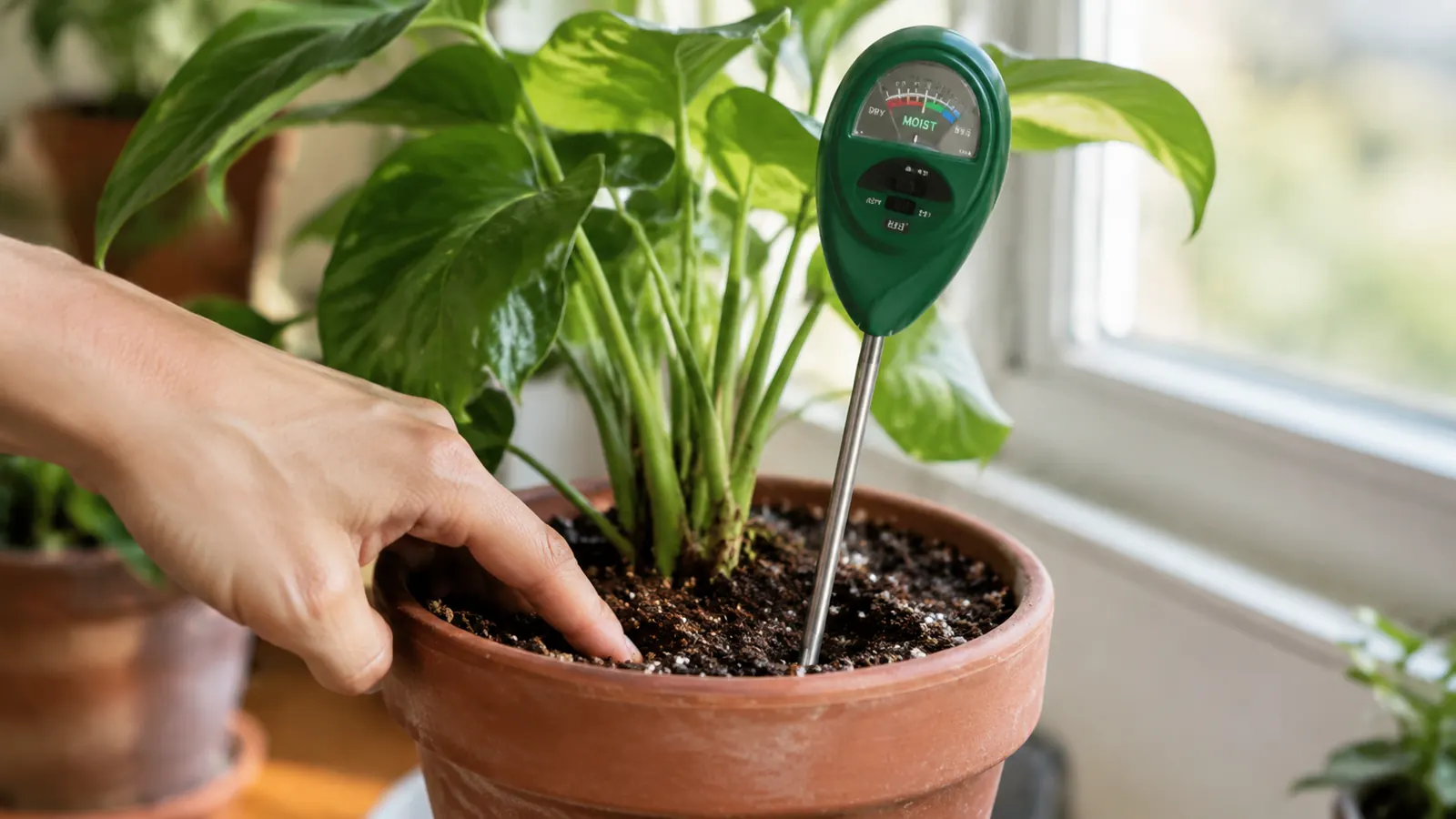
I killed a calathea by watering it on a schedule instead of on its actual needs. The top of the soil felt dry to my finger, so I watered, and the roots sat in damp soil all winter. That is the whole case for the XLUX moisture meter in one sentence. It reads the soil where the roots actually live, not just the surface where your finger happens to land. I have spent the last year using one on the 31 houseplants in my Portland apartment, and I have spent that same year doing the old finger test alongside it, because I wanted to know if the tool earns its shelf space or if it is just another gadget.
The short answer is that they answer two different questions. The finger test tells you whether the top couple of inches of soil are dry, which is enough for small pots and for plants that like to dry out between waterings. The XLUX tells you what is happening at root level, which matters for deep pots, for winter, and for anyone who has ever overwatered something to death. Both are useful. They are not the same tool, and pretending they are is how plants die.
| XLUX Moisture Meter | The Finger Test | |
|---|---|---|
| Cost | One-time purchase, no batteries, no refills, two probes in the pack | Free, forever, and already attached to your hand |
| Reading depth | Long probe reaches the root zone in deep pots | A finger reaches about two inches, which is surface level in a big pot |
| Objectivity | A number on a 1 to 10 scale, so dry means the same thing every week | Depends on your own skin, your pressure, and the day |
| Batteries and upkeep | Battery-free, nothing to charge or replace | No tool at all, so there is nothing to maintain or lose |
| Learning curve | About ten minutes to learn the scale, plus remembering to use it | You already know how, and there is no tool to find or clean |
| Best for | Anyone who has overwatered a plant to death and wants a clear signal | Experienced keepers who already read pot weight and soil feel |
In a deep pot, the top inch can dry out in a day while the bottom half stays wet for a week. Your finger reads the top inch. The roots live in the bottom half.
How I Compared Them
Here is the honest version of my test. For one year I watered my plants on Sunday mornings, the way I always have, because I cook most weeknights and commute by bike, so a weekday watering round never actually happens. Every Sunday I checked each plant twice. I pushed my finger into the soil about two inches, the way I did for fifteen years before I owned a meter. Then I pushed the XLUX probe into the same pot, waited about a minute, and wrote down the number it gave me.
The results were not dramatic. The meter did not save a single plant on its own, because no tool waters anything. But it changed my judgment in one specific way. My finger told me the top of the soil was dry. The meter told me the bottom of the pot was still damp. Those two readings disagree far more often than you would expect, and every time they disagreed, the meter matched what I found when I tipped the pot over and looked at the roots.
I did this with everything from Gus, my nine-year-old fiddle leaf fig in the east-facing living room window, down to small trailing plants in the north-facing bedroom that get no direct sun at all. The pattern held in both rooms. Shallow pots read the same on finger and meter. Deep pots read differently, and the difference is where the trouble lives.
I kept a simple log in a notebook. Date, plant, finger result, meter result, whether I watered. After a few months the log showed something I did not expect. The plants I watered only when the meter said 3 or below lost fewer leaves than the ones I watered on the old schedule. That is not a scientific study. It is one woman, one apartment, and one notebook. But it is my evidence, and it is better than the guess I used before.
The winter was the real test. Portland apartments run dry once the forced-air heat kicks on, and mine is no different. The air dries out, the top of every pot crusts over, and the finger test starts screaming dry at plants that are still wet six inches down. That is the season where I trusted the meter most, and it is the season where it saved me from my own worst habit.
Where XLUX Wins
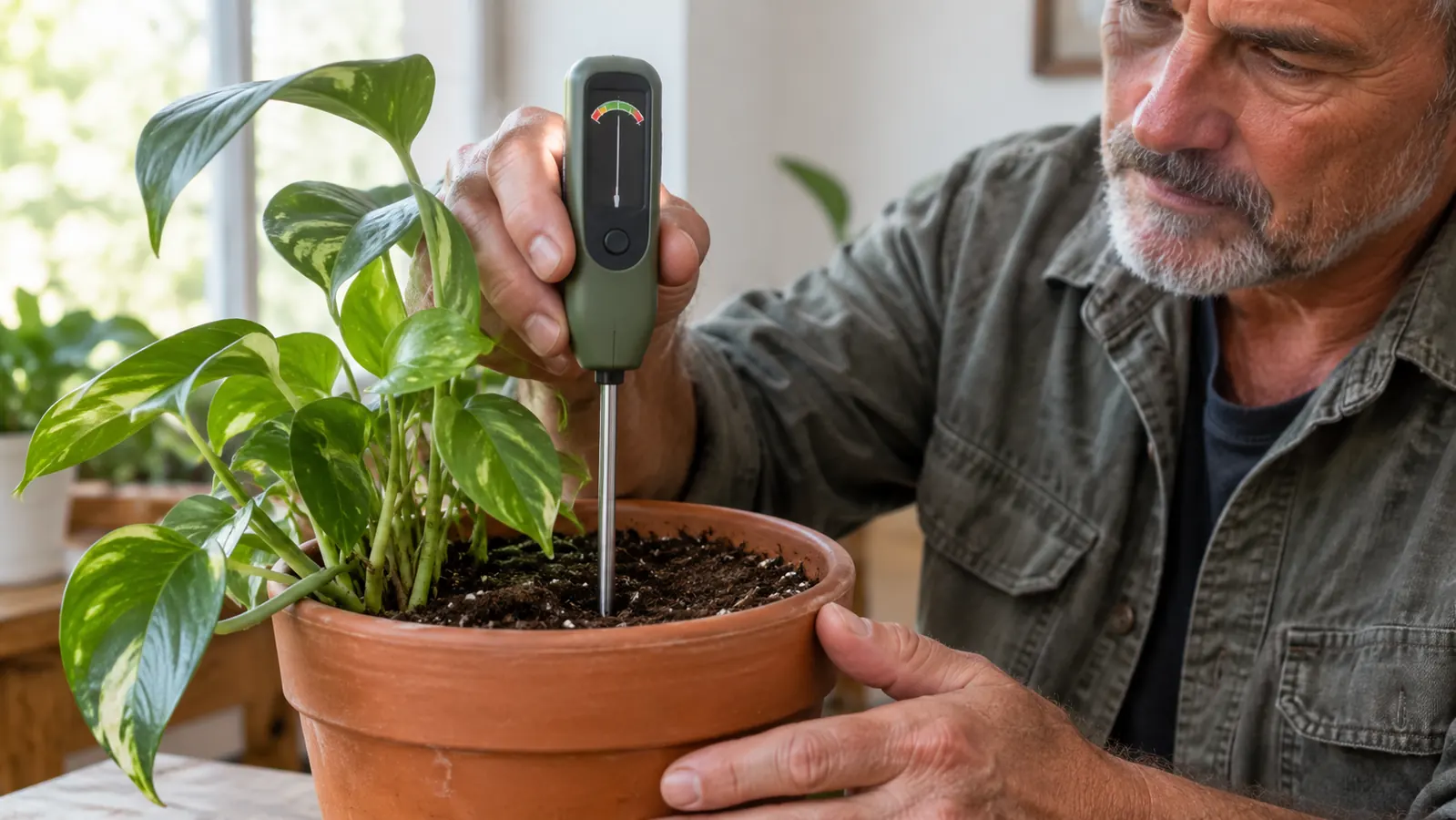
The biggest win is depth. My finger reaches about two inches into soil, and that is it. The XLUX probe is long, so it reads the root zone in a deep pot, which is where overwatering actually does its damage. The classic failure is a pot where the top inch dries out in a day but the bottom half stays wet for a week. Your finger says water. The meter says wait. In winter my apartment runs dry from forced-air heat, and the surface of the soil crusts over while the deeper soil stays damp. That is exactly the situation where a surface check lies to you.
The second win is that the meter gives you a number instead of a feeling. The scale runs from 1 to 10, where 1 to 3 means dry, 4 to 7 means moist, and 8 to 10 means wet. A number does something a fingertip cannot do. It makes dry mean the same thing every week. My sense of dry changes with the season, with how much coffee I have had, with whether I am in a hurry. The meter does not have moods. For anyone who has killed a plant by overwatering, that consistency is the whole value.
Where the Finger Test Wins
Now the part I have to be honest about. The finger test wins on cost, because it is free and it never wears out. It wins on availability, because it is always attached to your hand, and it works at a friend's house, in a store, anywhere you meet a plant you are curious about. It wins on learning curve, because you already know how to do it. There is no tool to find, no probe to clean, no scale to memorize, nothing to store in a drawer.
It also wins outright for small pots. If the pot fits in the palm of your hand, your finger reaches the bottom of the soil, and the meter adds nothing. The finger test also teaches you the skill the meter cannot teach you, which is the weight of a pot. Lift a pot when it is wet, lift it when it is dry, and your hands learn the difference. That skill travels with you forever, and it works even for plants the meter would never touch. My string of pearls died before I owned a meter, and no probe would have saved it. What would have saved it was me learning to leave it alone.
If you are going to stay with the finger test, here is how to make it work better. Push past the loose top inch and press into the firm soil underneath, because the loose surface dries out first and lies the most. Feel for coolness as much as wetness. Cool soil holds water even when it does not feel wet to a dry hand. And learn the weight of your pots when they are freshly watered, because that is the skill that will actually save your plants.
Read the root zone, not just the surface
The XLUX two-pack covers every pot I own, with a probe long enough to reach the bottom of a deep pot and a scale that tells dry from wet in about a minute. No batteries, no guesswork. Check today's price on Amazon and see if it earns a spot on your windowsill.
Amazon Check Today's Price on Amazon →How the XLUX Actually Works
Worth knowing, because it explains the limits. The XLUX has no battery. The two metal probes generate a tiny electrical current when they sit in moist soil, because moisture conducts electricity, and the meter reads how strong that current is. Drier soil conducts less, so the needle sits lower on the 1 to 10 scale. That is the whole mechanism, and it is why the meter lasts for years with nothing to charge.
The limit is that it measures moisture, not plant happiness. Some plants want to dry out completely between waterings, some want to stay evenly moist, and the meter does not know which is which. It tells you the soil is at a 3, and then you have to know whether that is the moment to water a pothos and the moment to leave a succulent alone. The meter is a better finger. It is not a brain.
How to Use It So the Reading Means Something
Three habits made the meter useful, and skipping any of them made it lie. First, push the probe down to root depth, not just an inch into the top. The whole point is that the surface lies, so do not read the surface. Second, leave it in the soil for about a minute before you trust the number, because the reading settles as the probe adjusts to the soil temperature. Third, wipe the probe clean after each pot. A dry, clean probe reads the next pot honestly, and a dirty one carries moisture from the last plant into the next reading.
The mistake I see people make is leaving the probe in the soil between waterings. It is not a watering spike, it is a measuring tool, and sitting in wet soil is not good for the metal over time. I also stopped testing right after I watered, because the reading is meaningless then. Every plant reads wet for a day or two, and that tells you nothing. The useful reading is the one you take a week later, when the top looks dry and you are trying to decide whether to pour.
What the Meter Still Can't Tell You
Two things can make the meter read wrong, and you should know both before you trust it blindly. Fertilizer salts in the soil conduct electricity, so a pot that was fed heavily can read wetter than it actually is. And the probe measures whatever soil it touches, so a pot with dry patches and wet patches gives you whichever patch you happen to hit. I take readings in two or three spots around the pot and go with the average, especially for bigger plants.
The larger limit is that moisture is not the same thing as need. Last winter the meter kept telling me Gus, my fiddle leaf fig, was still at a 5 near the roots while the top two inches felt bone dry. In the years before I owned a meter, I would have watered him on the surface reading and kept his roots wet through a Portland winter. Instead I waited, and he kept every leaf he went into winter with. The meter did not make that decision. It just gave me the one fact I kept getting wrong.
Who Should Buy Which
Buy the XLUX if you have ever watered a plant to death, if you keep anything in a pot deeper than your finger, or if you want watering to be a ten-second check instead of a worried guess. It earns its place fastest for people who killed something by overwatering and want a clear signal before they pour again. Skip it if every pot you own is small, if you already lift pots to feel their weight, or if you genuinely enjoy pressing your finger into the soil. You already have the tool.
If you are on the fence, start with the finger test and pay attention to pot weight for a month. If your plants are fine, you have saved yourself the money and the drawer space. If you still catch yourself watering on a schedule and hoping, that is the exact moment the meter pays for itself. I bought mine after the calathea died, and I have not lost a plant to overwatering since.
One more thing worth saying. The XLUX is not a gift for an experienced gardener, and I would not buy it for someone who has kept the same plants alive for a decade. It is a tool for the person who is trying again after a loss, and for that person it works. If that is you, the two-pack means you can keep one in the living room and one near the bedroom window, which is where mine live.
Water with evidence, not anxiety
If any of this sounds like your plants, the XLUX two-pack is worth a look. It takes a minute a week, needs no batteries, and tells you the truth about the root zone. Check today's price on Amazon and see whether it earns a spot next to your watering can.
Amazon Check Today's Price on Amazon →