
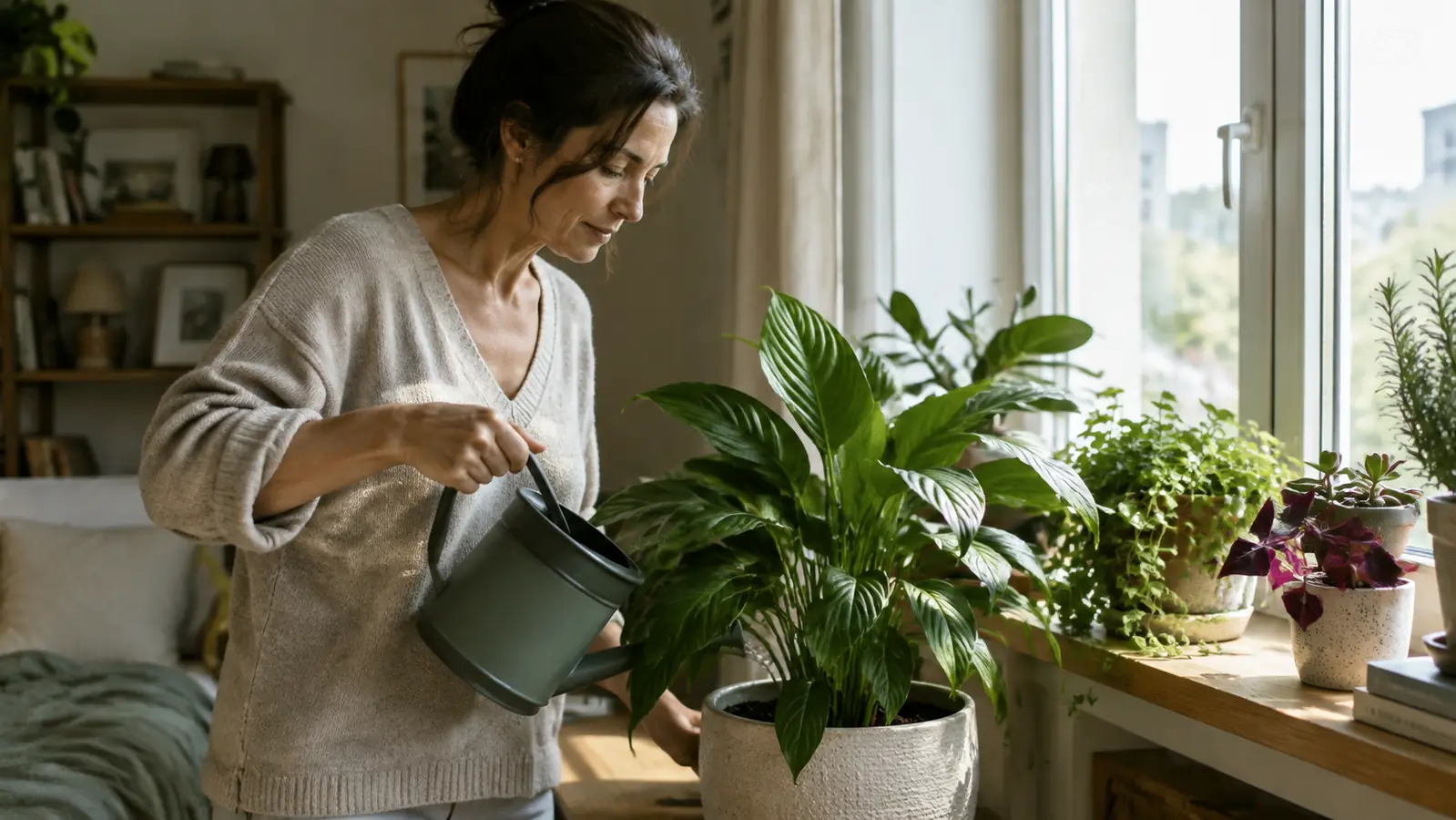
I bought the XLUX moisture meter the week after I killed my second calathea. The first one I blamed on the dry apartment air, because blaming the air is easier than blaming yourself. The second one had no such excuse. I had watered it on a schedule, faithfully, every Sunday, and the roots still rotted out from under it. That is when I finally admitted the problem was not the air. The problem was me, and the problem was that I could not tell what was happening three inches under the soil.
I have 31 houseplants in a third-floor walk-up in Portland, with no yard and no balcony, so everything I grow lives in a pot. For years I treated watering like a matter of faith. I would stick a finger in the soil, guess, and water if it felt dry. My finger is two inches long. The roots that matter are deeper than that, and the water that kills plants collects at the bottom of the pot, where a finger has never been. The XLUX is a two-pack of battery-free probe meters. You push the long metal probe into the soil, wait for the needle to settle, and read a scale that tells you whether the soil is dry, moist, or wet. It also reads light and pH, which I mostly ignore. Six months later, it is the tool I reach for every Sunday morning, and it has not stopped me from killing plants. It has stopped me from killing them out of pure guesswork, which is a different and better thing.
The Quick Verdict
A simple, battery-free probe that tells you what is actually happening at root level. It will not make you a better plant keeper by itself, but it will stop you from watering on faith, and for me that was worth the shelf space.
Amazon Check Today's Price →Stop guessing whether your plants need water
The XLUX two-pack has lived on my windowsill for six months and gets used every single Sunday. If you have ever watered a plant that did not need it, this is the fix that actually works.
Amazon Check Today's Price on Amazon →How I've Used It
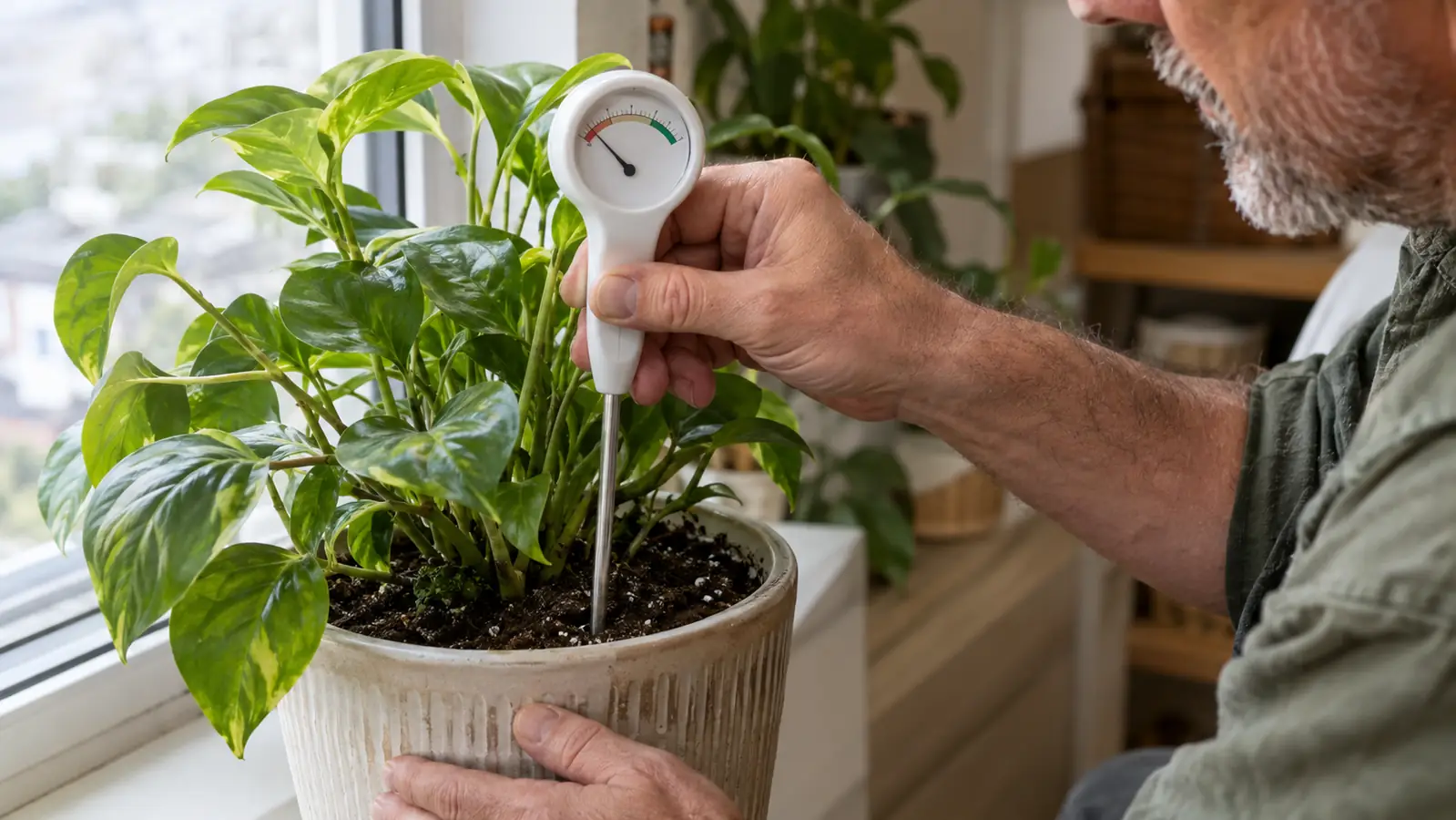
My routine has been the same every Sunday morning since the meters arrived. Coffee first, then the probe. I go through the apartment pot by pot, push the probe down to about three quarters of the pot depth, and wait for the needle to stop moving. It takes about a minute per plant. Thirty-one plants means roughly half an hour, which is the same amount of time I used to spend second-guessing myself and watering things that did not need it.
The readout is divided into color zones. Red means dry, green means moist, blue means wet. I learned within a few weeks that the middle of the green zone is the target for most of my plants. Anything reading blue, I skip that week, no matter how dry the top of the soil looks. That single rule changed my watering more than any other piece of advice I have read, because it replaced a feeling with a fact.
Gus, the fiddle leaf fig I have kept alive for nine years, sits in the best window in the apartment and gets the deepest pot I own. Before the XLUX, I watered him every Sunday out of habit. The meter told me he was still moist four Sundays in a row, so I stopped. He has put out three new leaves since, which is more than he did in the entire previous year.
The two-pack turned out to be the right call. One meter lives in the living room by the east window, where most of my plants are, and the other lives in the bedroom, where the north-facing window means everything grows slower and needs less water. I would not have thought the bedroom plants needed a different watering rhythm than the living room ones. The meter proved it within a month. The plants in the north room stay moist for almost two weeks in winter, and the ones in the east window dry out in five or six days. Same apartment, same water, completely different schedules.
What the XLUX Actually Measures
Here is what surprised me about a meter with no batteries and no screen: it is not measuring anything digital. The two metal probes act as a conductivity sensor. Wet soil conducts electricity better than dry soil, and the needle moves according to how much current passes between the probes. That is the whole mechanism. There is nothing to charge, nothing to calibrate, and almost nothing to break.
The main scale runs from one to ten, with color zones overlaid on top. I use the colors far more than the numbers. The numbers add a little resolution when I am tracking a plant from week to week, but the colors are what I act on. A plant sitting in the blue zone at the bottom of the pot does not need water, full stop, regardless of how pale the surface looks.
There is a second readout for light and a switch for pH readings. I will be honest about both: I have used the light reading maybe three times, and the pH reading once, just to confirm the switch worked. If you need reliable soil pH for a fussy plant, buy a real pH meter. The XLUX is a moisture meter first. Everything else on it is a bonus I mostly ignore.
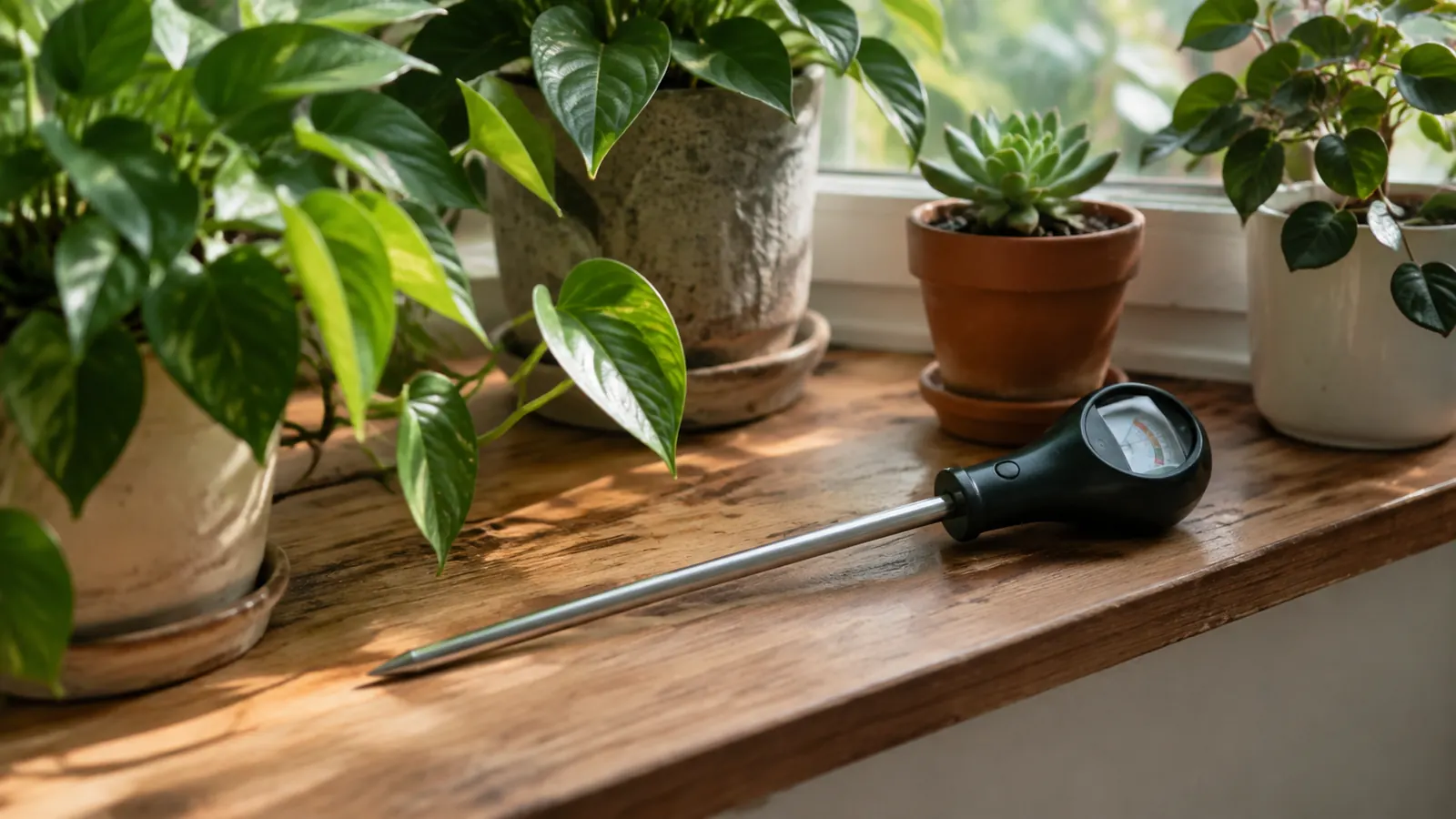
Battery-free matters more than it sounds like it should. I have owned a digital hygrometer for years, and right now it sits in a drawer dead because I did not have the right battery when it ran out. The XLUX has no such failure mode. It is a piece of metal and plastic with a needle. It works the same in February as it did in August, and it will work the same years from now, as long as I keep the probes clean.
The Long Probe Matters More Than I Expected
Most of the mistakes I made as a plant keeper happened because I was watering based on the top two inches of soil. The surface dries out fast, especially in a Portland apartment with forced-air heat running all winter. But the roots are not in the top two inches. They are in the middle and bottom of the pot, and that is where the water actually sits between waterings.
The probe on the XLUX is long enough to reach the bottom of a standard six or eight inch nursery pot. That changes the question you are asking. Instead of 'is the surface dry?', you get to ask 'is there still water sitting down at the root ball?'. Those are two completely different questions, and only one of them prevents root rot.
I learned this the hard way with my string of pearls. The top of that pot was bone dry every time I checked it. The meter read wet near the bottom, because water had collected in the saucer and the lower half of the pot never dried out. I had been watering it for months thinking I was helping. I was drowning it. The XLUX showed me exactly what was happening, and I still lost the plant because I did not act on the reading quickly enough. That one is on me, not on the meter.
The meter told me Gus was still moist four Sundays in a row, so I stopped watering him. He has put out three new leaves since, more than in the entire previous year.
Where It Falls Short
Now the parts I do not love, because a review that only praises a product is not worth reading. First, the meter needs some moisture in the soil to work at all. If the mix is completely bone dry, the needle barely moves, because there is nothing to conduct the current. That sounds like a strange flaw in a moisture meter, but it is just physics. In practice, this means the XLUX is excellent at telling you when not to water, and only so-so at telling you exactly how dry a fully dried-out pot is.
Second, the reading depends on the probe touching soil. Air pockets in chunky mixes, or a root sitting right where you pushed the probe in, will give you a reading that does not match reality. I take two readings in different spots on any pot where the first number looks off. Third, you have to clean the probes after use. I wipe mine with a dry cloth every Sunday. If you leave the probe pushed into wet soil for days, the metal will rust. The instructions warn about this, and they are right.
Fourth, the needle is slow. It takes a full minute to settle on a stable reading. That is not a problem when you are going pot to pot, because you can move on and come back, but it is worth knowing before you buy. You will not get an instant answer.
Alternatives I Considered
Before I settled on the XLUX, I weighed three alternatives. The first was the finger test, which is the method I had used for years and the reason I killed a maidenhair fern and two calatheas. My finger is two inches long. The water that rots roots sits deeper than that. The finger test tells you about the surface, and the surface is the least useful place to look. I compared the two methods in detail in a separate article, and the short version is that the probe wins because it reaches the root ball.
The second alternative was a digital meter with a numerical readout and a battery. I looked at those seriously, and the battery is exactly the problem. A device that needs charging is a device you will not have when you need it. The XLUX has no battery, no screen, and no settings. It cannot run out of anything. That simplicity is the whole appeal.
The third alternative was to move everything to self-watering pots and stop watering by hand altogether. That is a bigger change than I wanted to make to 31 plants that were mostly fine with how I already cared for them. The meter fixed the actual problem I had, which was ignorance about what was happening below the surface, without asking me to repot my whole collection.
What Six Months of Daily Use Taught Me
The biggest lesson is that most plants do not need water on a schedule. They need water when the soil at the bottom of the pot has dried out, and that moment is different for every plant in the apartment. The meter did not change my plants. It changed my timing, and timing is what was killing them.
The second lesson is that the meter is only as good as the question you ask it. I do not use it to decide whether a plant looks happy. I use it to answer one narrow question: is there still water at the bottom of this pot? If the answer is yes, I walk away. If the answer is no, I water until a little runs out the drainage holes, then I check again in a week. That narrow question has been more useful than every general care guide I have read, because it is specific to my pots, my windows, and my watering habits.
The third lesson is harder to put in a review. The meter did not make me a better plant keeper overnight. It made me a more honest one. When something dies now, I cannot tell myself I did everything right, because the readings were right there and I chose to ignore them. That honesty is uncomfortable, but it is also how I finally learned which of my plants like to dry out between waterings and which ones want to stay evenly moist. No care guide could have taught me that about my specific apartment.
What I Liked
- Battery-free, so there is nothing to charge, replace, or forget
- Long probe reaches the root ball instead of just the surface
- Simple color zones make the reading easy to act on
- Two meters in the pack, so one can live in each room
- Took the guesswork out of my Sunday watering routine
Where It Falls Short
- The needle takes about a minute to settle on a reading
- Needs some moisture in the soil to work, so bone-dry mixes read unreliably
- Probes will rust if you leave the meter pushed into wet soil
- The light and pH functions are too basic to trust for anything precise
Who This Is For
Buy the XLUX if you are an apartment plant keeper who waters on a schedule out of habit, the way I did. If you have ever killed a plant by overwatering, which is the most common plant death there is, this meter tells you the one thing you actually need to know: whether there is still water at the bottom of the pot. It is also for people with busy weeks, because a thirty second check on Sunday tells you which plants can wait and which ones genuinely need water before the week starts. And if you want the full list of reasons I think every houseplant keeper should own one, I wrote them all out in a separate article.
Who Should Skip It
Skip it if you only own a few plants that you already know well. If you can look at your pothos and tell whether it needs water, you do not need a meter to confirm it. Skip it if you grow mostly plants in chunky bark mixes, like orchids, because the probe needs soil contact and airy mixes give unreliable readings. And if you want precise numbers, a bright screen, and pH readings you can trust, buy a digital meter instead. The XLUX is not a laboratory instrument. It is a tool for people who want to stop guessing, and that is exactly what it does.
Six months in, it is still the first thing I reach for on Sunday
The XLUX two-pack has saved more of my plants than any other tool I own. If you are tired of watering on faith, this is where I would start.
Amazon Check Today's Price on Amazon →