
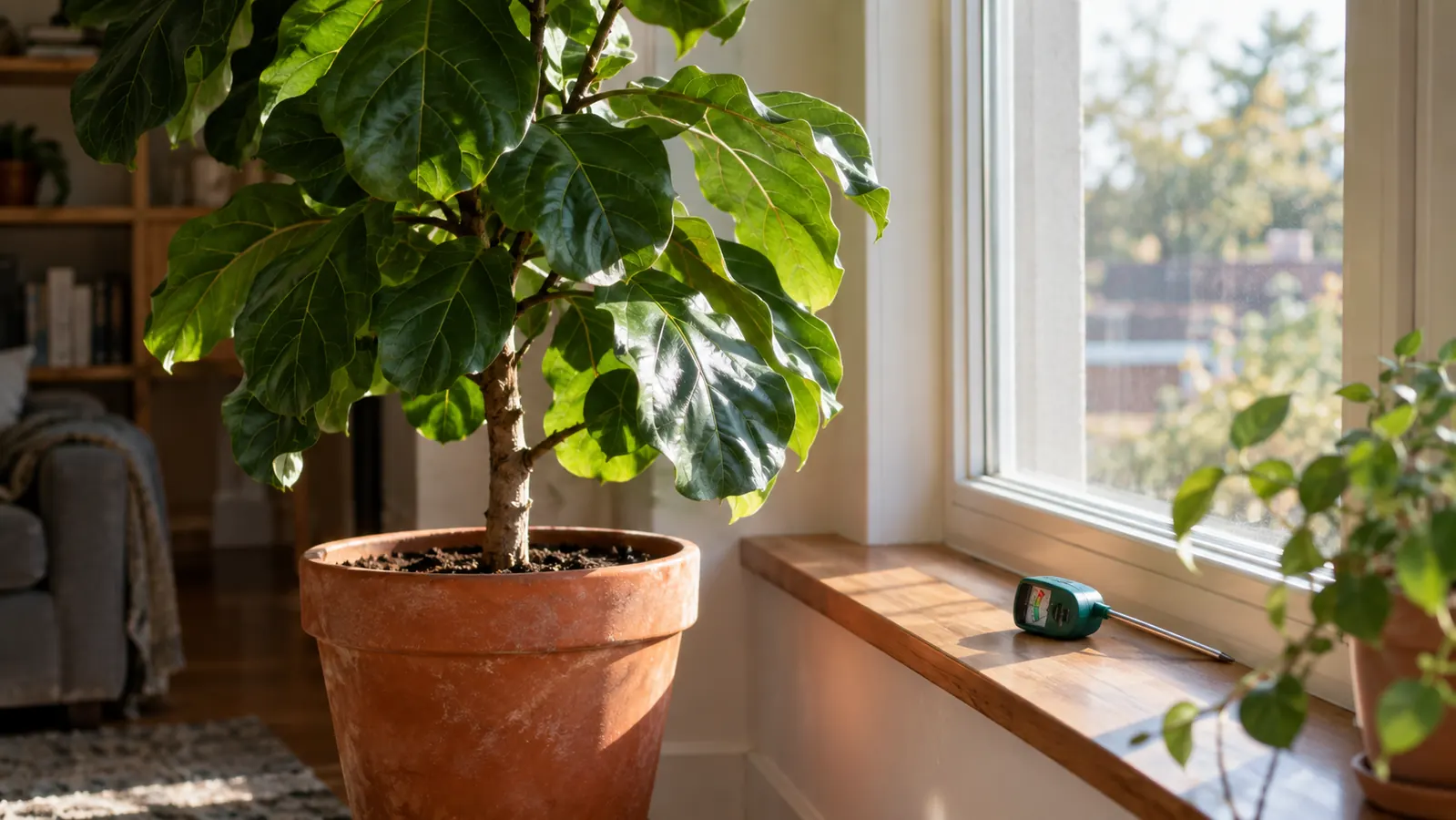
Every Sunday morning I do the same circuit through my apartment with a watering can. I check the calatheas in the bedroom, the trailing plants on the shelf, and then I stop in front of Gus, my nine-year-old fiddle leaf fig, and I stick my finger into his soil. For years that finger test was the whole system. Then I bought the XLUX moisture meter, a two-pack of battery-free probes, and I learned that my finger had been lying to me.
The Quick Verdict
The XLUX moisture meter is the rare tool that pays for itself in the first season. It will not fix overwatering on its own, but it will show you exactly when your soil is dry an inch down, which is the difference between watering on a schedule and watering when your plant actually needs it.
Amazon Check Today's Price →Stop trusting your finger. Start trusting a reading.
The XLUX two-pack gives you a battery-free probe for every room. It takes ten seconds, it needs no calibration, and it has already saved me from one very expensive mistake. Check today's price on Amazon.
Amazon Check Today's Price on Amazon →How I've Used It
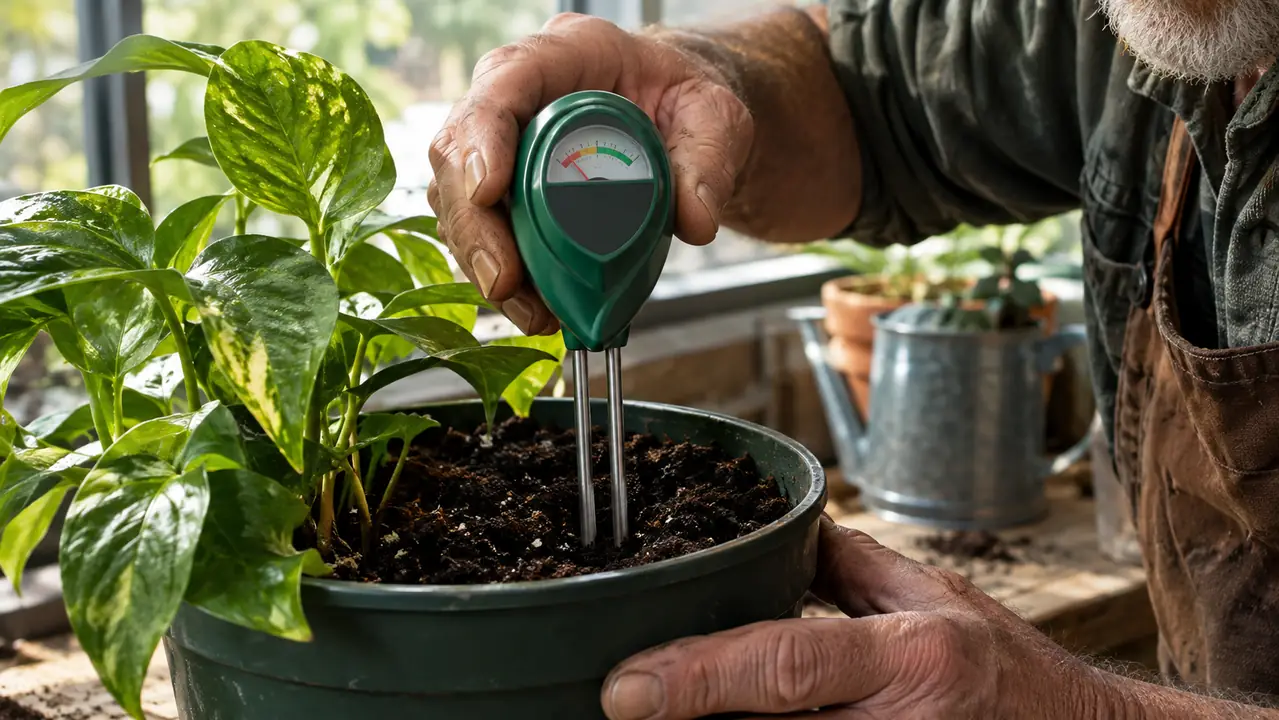
I water on Sunday mornings because I cook most weeknights and commute by bike, so a weekday watering round never actually happens. The XLUX lives in a drawer by the kitchen window, and every Sunday I pull it out before I fill the can. I push the probe into each pot, wait about thirty seconds for the needle to settle, and write the number on a scrap of paper taped to the fridge. It sounds obsessive. It is the only reason my 31 plants made it through last winter.
Portland winters are wet outside and dry inside. Our forced-air heat runs from October to April, and by January the air in my third-floor walk-up is dry enough that my knuckles crack. The XLUX reads soil moisture, not air humidity, so it does not solve the dry-air problem. What it does is stop me from watering a pot that is still damp two inches down, which is how I killed my first calathea. I watered on a schedule. The schedule did not care that the soil was still wet.
Gus is the test case. He is a fiddle leaf fig I have kept alive for nine years, which sounds impressive until I tell you that I killed a string of pearls, two calatheas, and a maidenhair fern in that same apartment. Gus sits in the east-facing window and gets direct sun until about 11am. The XLUX reads his soil at around 4 in summer and around 2 in winter. When it drops below 3, I water. When it sits at 5, I wait. That single number replaced nine years of guessing.
I started with the bedroom plants because they were the ones I kept losing. My string of pearls died in 2022 because I watered it every Friday without checking the soil. The XLUX showed me that the top of that pot dried out in three days while the bottom stayed damp for ten. By the time I understood that, the plant was gone, but the lesson stuck. Now the trailing plants in the bedroom get checked every Sunday with the second probe, and I have not lost a calathea since I started writing the numbers down.
Why the Right Reading Matters More Than the Gadget
Here is what nobody tells you about houseplant care. Overwatering is not about how much water you pour. It is about how often you pour it. A moisture meter does not tell you when to water. It tells you when not to water, and that is a far more useful piece of information. My finger could feel the top of the soil. The XLUX probe reaches down past the top inch and shows me what is happening where the roots actually live.
Here is the thing I learned the hard way. The top inch of soil can feel bone dry while the bottom half of the pot is still soggy. If you water based on the top inch, you are topping up a pot that has not finished draining from last week. The XLUX does not care what the calendar says. It does not care that I watered last Sunday and the routine says I should water again. It gives me a number, and I have learned to trust the number over the habit.
One Sunday last March I took readings from every pot before I watered anything. Gus sat at 5, the bedroom calatheas at 4, and a small pot of pothos at 1. The pothos got water. The others did not. That ten minute check meant I did not pour water into four pots that were still fine, and it meant the pothos got a drink before it started to wilt. That is the practical difference between a routine and a habit. A routine waters everything because it is Sunday. A habit waters the one plant that needs it.
What the XLUX Gets Right
The first thing is the battery-free design. There is nothing to charge, nothing to replace, nothing to break. The probe works by electrical resistance, which means it is about as simple as a tool can be. I have dropped it on a tile floor twice. It still reads fine.
The second is the two-pack. One lives near Gus in the living room. The other stays in the bedroom for the calatheas and the trailing plants. I do not have to carry a single probe from room to room, which means I actually use it. The dial is divided into dry, moist, and wet zones. I do not need to remember which number means what. I just look at where the needle lands.
The third is the long probe. My deepest pots are the ones I always misjudged, because the top few inches dried out fast while the bottom stayed heavy. The XLUX probe reaches down far enough to tell me what is happening at root level. That is the reading I was missing for years.
The build is not fancy, and that is exactly why I trust it. The housing is plain, the dial is basic, and there is no app to pair or firmware to update. I have owned it for fourteen months. It still sits in the drawer every Sunday and it still gives the same reading on the same pot that I checked the week before. When a tool is this simple, there is very little to go wrong, and very little to argue with.
What I Liked
- Battery-free and nearly indestructible; no charging, no calibration, no parts to fail.
- Reads moisture a few inches down, where the roots live, instead of just the dry surface.
- Two probes in one pack, so I can keep one in the living room and one in the bedroom.
- Works on any potted plant with soil, from a fiddle leaf fig to a tray of seedlings.
- The dial is simple enough that I trust it on Sunday mornings when I am half awake.
Where It Falls Short
- It only measures moisture, not light, humidity, or nutrients, so it is a single tool, not a complete plant-care system.
- The probe can scratch roots if you push it in too hard, especially in dense, compacted soil.
- It is not waterproof. You need to wipe the probe dry after each use, which I forget more often than I should.
- The reading depends on how firmly the probe sits in the soil; loose contact gives a misleading number.
My finger told me Gus was dry. The XLUX told me he was fine. I listened to the meter, and the new leaf unfurled a week later.
The One Reading That Nearly Cost Me Gus
Last February, after a string of grey days, Gus started dropping lower leaves. The oldest leaves yellowed at the edges and then went brown. My first instinct was to water him. He looked thirsty. The XLUX said 6 on the moist side, which was the last thing I expected. I almost ignored it. I had already filled the watering can. Instead I waited, and I checked the pot's drainage, and I realised the real problem was not dry soil. The pot had been sitting in a saucer of water after a heavy watering two weeks before. The roots were not thirsty. They were drowning.
Here is the part that still embarrasses me. I have kept this plant alive for nine years, and I was about to kill him with kindness. The meter did not fix the drainage. I fixed the drainage. But the meter gave me the one piece of information I did not have: the soil was already wet. Without that number, I would have poured a full watering can into a pot that was already waterlogged. Gus would have been my fourth casualty instead of my oldest survivor.
After I tipped the saucer dry and let the pot drain for a day, Gus perked up. The yellowing stopped. A new leaf unfurled three weeks later. That is the whole case for this tool. It does not make you a better plant parent. It gives you the information you were guessing at, and the information does the work.
What Nobody Tells You About the Finger Test
The finger test is not useless. It is just incomplete. A fingertip reaches about half an inch into the soil, and that half inch dries out far faster than the rest of the pot. By the time the surface feels dry, the deeper soil can still be holding plenty of water. If you water by the finger test alone, you will overwater the plants in deep pots and underwater the plants in shallow ones.
Nobody tells you that a moisture meter needs a little technique. You cannot just stab it into the soil and read it. You need to push it in at a slight angle, make sure the probe is touching soil rather than a root or the side of the pot, and wait for the needle to stop moving. If the soil is very dry, the needle can take thirty seconds to settle. I have learned to leave it in place while I check the next plant.
Nobody tells you that the meter is only as good as your routine. I use mine on Sundays, at the same point in the day, after the same amount of time since the last watering. That consistency makes the numbers comparable. A reading of 3 on a Sunday means something different from a reading of 3 on a Tuesday, because the plant has had different amounts of time to drink.
The XLUX two-pack is not a magic wand. It cannot tell you whether your window is bright enough, whether your tap water is too hard, or whether the dry winter air is the real problem. For that, you still need eyes, a calendar, and a little humility.
One more thing I wish someone had told me: the meter is a second opinion, not the final word. Last spring one of the calatheas read 4, which should have meant fine, but the leaves were curling anyway. I trusted the number and waited. A week later the plant was worse. The problem was not the soil moisture, it was the dry forced-air heat, and the meter cannot measure that. I moved the calathea to the bathroom where the air is wetter, and it recovered. The meter was right about the soil and useless about the room.
Who This Is For
This is for the person who has killed a plant with kindness. If you water on a schedule because you read somewhere that plants like routine, and then you wonder why the roots rot, this meter will show you the exact moment your schedule and your soil disagree. It is also for the person with deep pots, the ones you can never judge by weight, and for anyone who travels and hands plant care to a neighbour. Write the numbers on a sticky note and the neighbour will know exactly what to do.
This is for the person who wants to stop guessing. I am not a botanist. I am a woman with 31 houseplants, a third-floor walk-up, and a history of killing things I cared about. The XLUX does not judge me. It just tells me the truth about the soil, and the truth is easier to act on than a guess.
It is also for the renter with no yard and no balcony, the person who has to make one good east-facing window do all the work. I live in a third-floor walk-up in Portland. I do not have a greenhouse or a grow tent. I have a windowsill, a shelf, and a bathroom that stays humid after a shower. A tool that tells me when to water and when to wait is worth more to me than a shelf full of fancy fertilisers, because the watering mistake is the one I kept making.
Who Should Skip It
If you have two plants and you can lift the pots to feel their weight, you may not need a meter. The weight test is a legitimate method, and a moisture meter is one more thing to store. If your plants are all in small pots that dry out in a day or two, the finger test is probably fine. If you are the kind of person who enjoys the ritual of checking each plant by hand, this tool will feel like a middleman.
Skip it if you are looking for a complete plant-care system. The XLUX measures moisture and nothing else. It will not tell you why a leaf is yellowing, why new growth is pale, or why the soil is crusty. It is a moisture meter. It does one job, and it does that job well. If you need light, humidity, and nutrient levels, you need other tools, and no single probe will replace them.
Skip it if you will not use it. A meter in a drawer is just a piece of plastic. The value comes from using it every week, at the same time, and actually trusting the number over your instincts. If that sounds like too much work, save your money and stick with the finger test. You will kill fewer plants with a consistent routine than with a gadget you ignore.
The two-pack costs less than the plant it saved.
I bought the XLUX to stop guessing, and it paid for itself the day it stopped me from watering Gus. If you have ever killed a plant by loving it too much, this is the tool to try first. Check today's price on Amazon.
Amazon Check Today's Price on Amazon →