
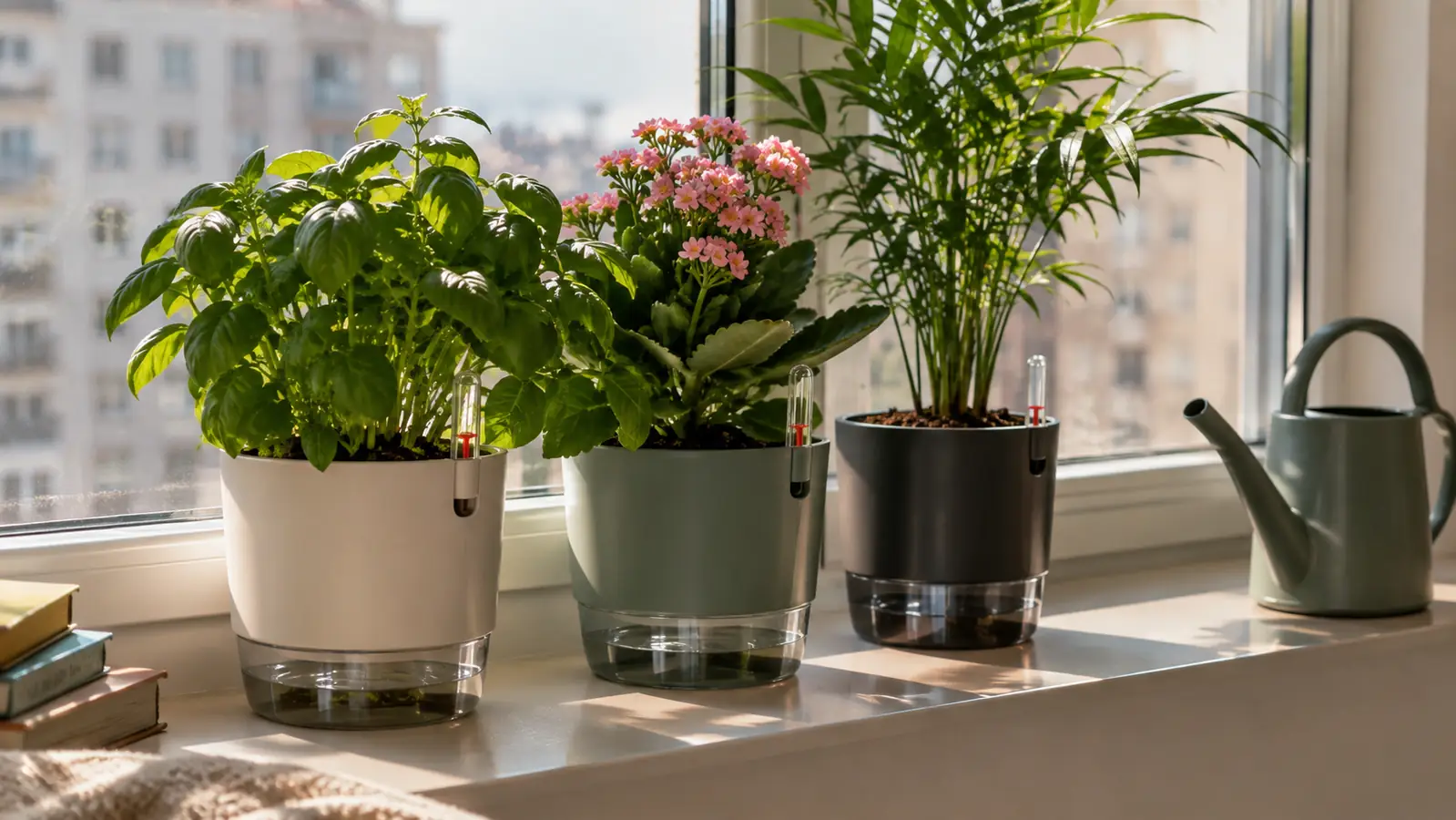
I killed my string of pearls in a standard plastic nursery pot. Then I killed a calathea in another one. Both deaths came down to the same week: I watered on Sunday, got busy, and by the following Friday the top of the soil was bone dry and the roots were already in trouble. The string of pearls collapsed into mush, and the calathea curled its leaves so tight they never fully relaxed again. So when I brought home the GARDENIX DECOR self-watering pots, I did not test them on my easiest plants. I put them next to the standard pots they replaced, on the exact plants that had struggled most, and I ran the comparison for six weeks.
The short answer: the GARDENIX pots forgave a missed week, and the standard pots did not. One of my two calatheas is now in a GARDENIX pot and has put out two new leaves. The other stayed in a standard pot and dropped three. That difference is the whole review.
How I Tested
I have 31 houseplants in a third-floor walk-up apartment in Portland, Oregon, with no yard, no balcony, and no greenhouse. What I do have is one good east-facing window in the living room that gets direct sun until about 11am, one weak north-facing bedroom window that gets none, and forced-air heat that dries the apartment out every winter. My watering routine is fixed: Sunday mornings, because I commute by bike and cook most weeknights, so a weekday watering round never actually happens. That routine is also fragile, and I wanted to know which pot survived the weeks when it broke.
I set up the test on the first Sunday of the month. On the east-facing shelf I put two calatheas of similar size, both bought from the same nursery in the same week. One went into a GARDENIX DECOR pot with the water level indicator showing full. The other stayed in its original standard plastic nursery pot with drainage holes and a saucer. Both got the same tap water that had sat out overnight, the same light, the same room temperature. I also moved a pothos cutting and a small fern into GARDENIX pots and left their standard-pot counterparts where they had been living. I marked each pot with a piece of masking tape and the date, so I would not mix them up when the plants started to look different. Then I waited, and I took notes on the same day every week for six weeks.
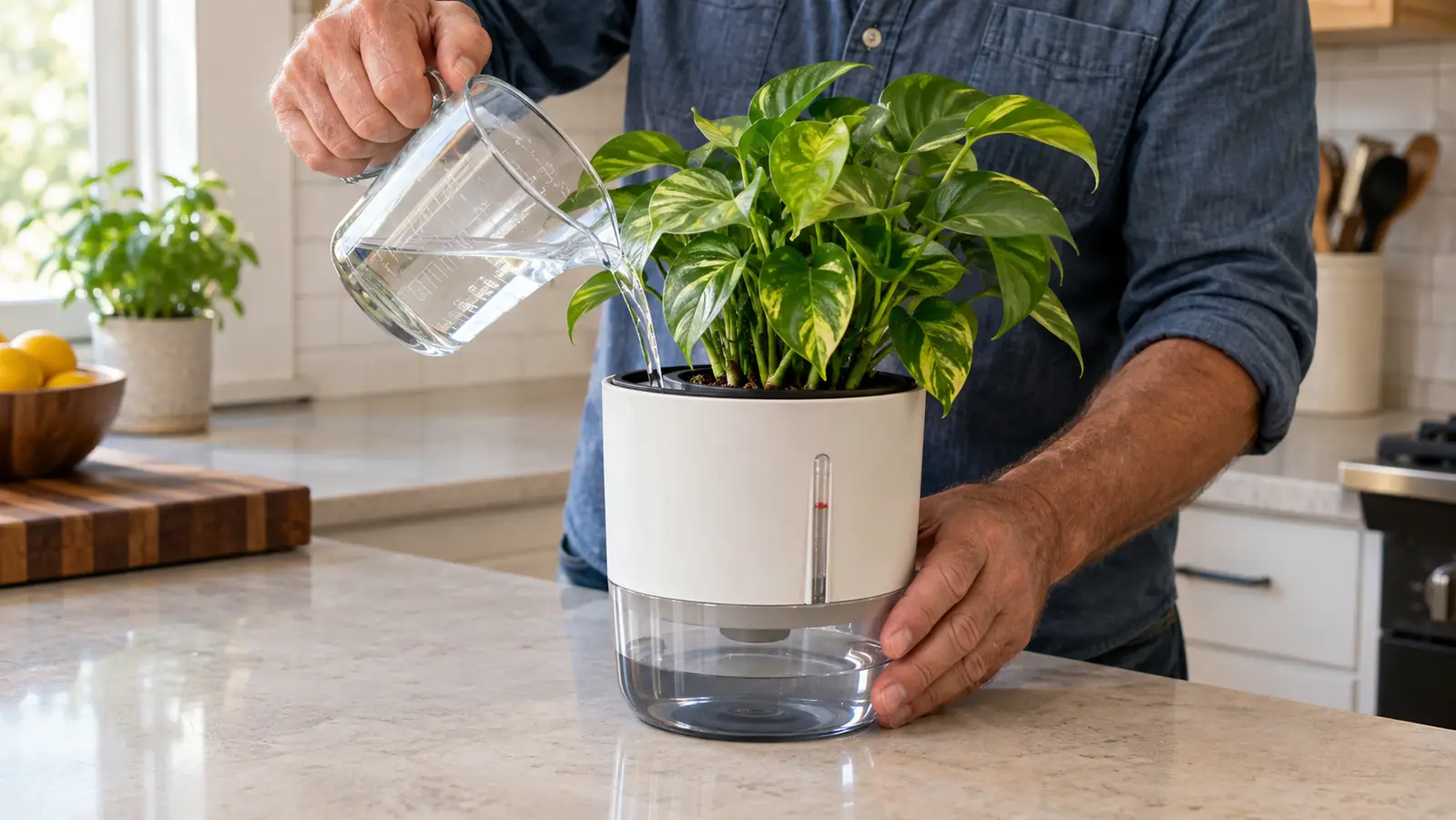
The GARDENIX DECOR pot holds a 1.2 liter reservoir under the inner pot, and the wick draws water up as the soil dries. The standard pot holds nothing. That is the whole mechanical difference, and it shows up in exactly one situation: the week you forget to water. On a normal week, both pots do fine. The difference only appears when the schedule breaks. I did not fully believe the reservoir would work until I saw the calathea in the GARDENIX pot look unchanged on day five, then day six, then day seven. It looked like a plant that had been watered that morning, because it had been, slowly, from below.
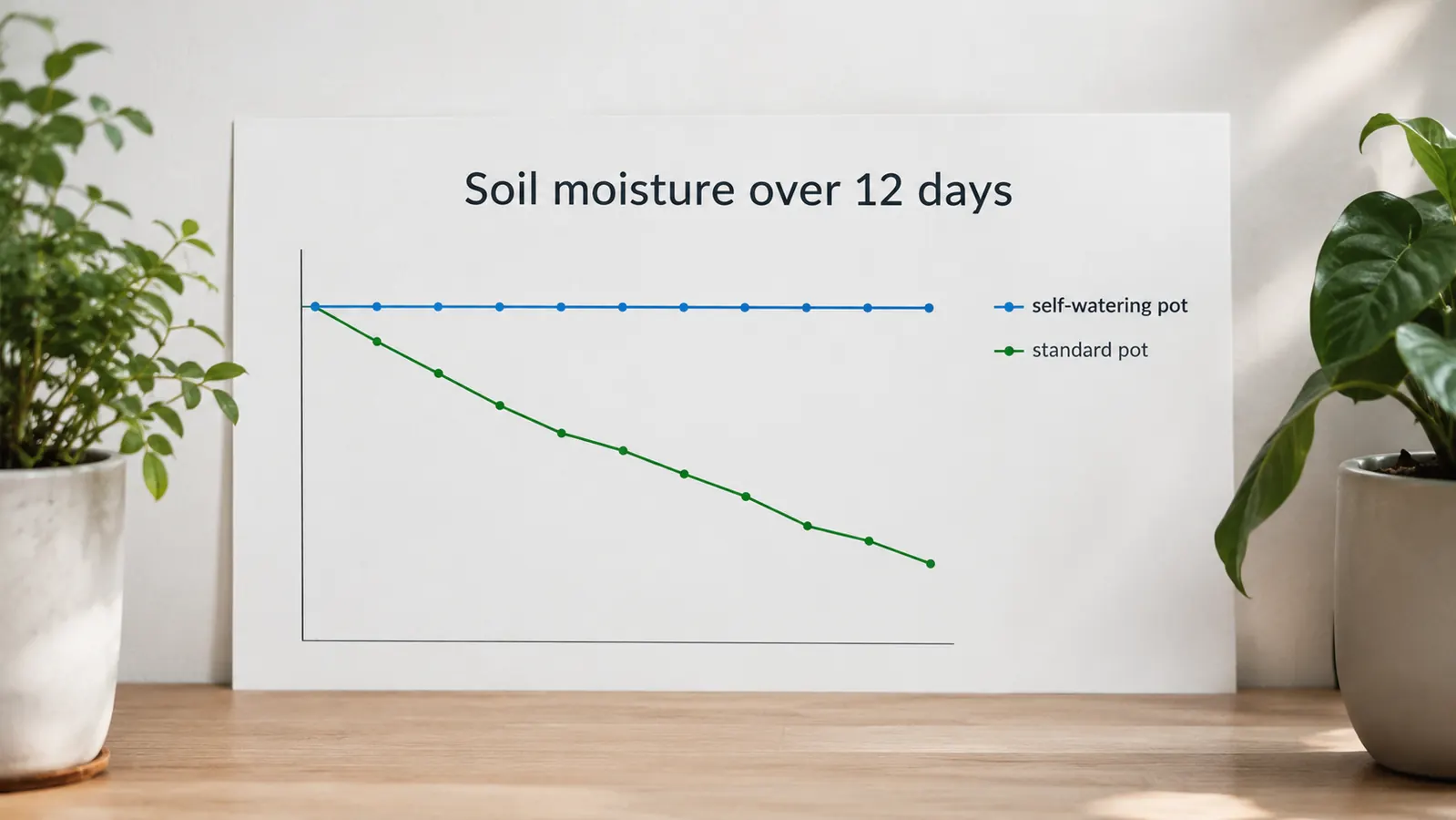
I also weighed the pots on the same kitchen scale every Sunday before refilling. The standard calathea pot lost about a pound of water weight between waterings, which told me how fast it was drying. The GARDENIX pot lost almost nothing from the top section, because the reservoir was feeding the soil from below. That weight difference is the most concrete thing I measured, and it explains why the two plants behaved so differently when I missed a week. The standard pot went from soaked to dust in about four days. The GARDENIX pot stayed in the middle of the range for the whole seven days.
| GARDENIX Self-Watering Pot | Standard Plastic Nursery Pot | |
|---|---|---|
| Watering schedule | Reservoir carries the plant through a missed week; I refill every 7 to 10 days | Needs water every 3 to 4 days in the same conditions, no forgiveness |
| Water level visibility | Clear indicator shows when the reservoir is low, no guessing | No indicator at all; I had to lift the pot or stick a finger in the soil |
| Root health after a dry week | Calathea kept moisture at the roots, two new leaves in six weeks | Calathea dropped three leaves in the same six weeks |
| Risk of overwatering | Possible if you refill before the reservoir is low; the indicator helps | Easy to drown the roots if you water on a fixed day regardless of need |
| Looks on a windowsill | Clean matte finish, three pots in the pack look intentional together | Thin plastic, no visual weight, I kept them in cachepots anyway |
| Price | Costs more than a nursery pot, but you are paying for the reservoir and indicator | Nearly free, often comes with the plant, replaceable anywhere |
Where GARDENIX Wins
The first GARDENIX DECOR win is the water level indicator. On the standard pots, I had no way to know what was happening below the surface. I would push a finger into the soil, decide it felt dry, and water. Some weeks that was right. Some weeks it was not, and the string of pearls that died last year was a plant I watered on schedule even though its soil was still damp. The indicator on the GARDENIX pot sits at the side and shows the reservoir level at a glance, so I refill when it is low and I leave it alone when it is not. That single change removed most of my guesswork. It also changed how often I checked the plants, because checking the water level is easier than sticking a finger in every pot. I found myself walking past the shelf and just glancing at the little float, the way you glance at the gas gauge on a car.
The second win is consistency through a missed week. In the third week of the test, I had a stretch where work ran late four nights in a row and I did not touch any plant until Thursday. The GARDENIX calathea looked fine. The standard-pot calathea had drooped noticeably, and its soil had pulled away from the edge of the pot. I watered both the same evening, but the standard one had already lost a leaf and went on to lose two more. The GARDENIX one never dropped a single leaf. That is the forgiveness I bought, and it worked exactly when I needed it. I checked the indicator after that week and it still showed water in the reservoir, which told me the plant had not been running on empty the whole time. On the standard pot, the soil had shrunk into a hard disk that took two waterings to rehydrate properly.
The third win is how the pots look on the shelf. The GARDENIX pots have a clean matte finish and a water level indicator that reads like a small instrument, not a toy. The three pots in the pack look intentional together, which matters in an apartment where every windowsill is visible. The standard nursery pots are thin plastic, and I kept most of them inside decorative cachepots anyway. The GARDENIX pots are the first pots I have owned that I do not feel the need to hide.
Where Standard Pots Win
Standard nursery pots win on price, plain and simple. They come with the plant, they are everywhere, and if one cracks you can replace it for pocket change. They also dry out faster, which sounds like a downside but is actually useful for plants that like to dry between waterings, like my pothos. In a GARDENIX pot, the pothos cutting stayed more evenly moist than it preferred, and I had to be careful not to refill the reservoir before it ran low. The standard pot let the soil dry the way the plant wanted. I noticed the difference most in week four, when the pothos in the GARDENIX pot started showing slight yellowing at the leaf tips, the classic sign of soil that stays too wet. I moved that pothos back to a standard pot at the end of the test, and the yellowing stopped.
Standard pots also win on overwatering risk. A self-watering pot can keep the soil too wet if you refill it on a fixed schedule instead of watching the indicator, and the reservoir means the bottom of the soil stays moist even when the top looks dry. Plants that want a real dry period, like snake plants or my string of pearls before it died, do better in a pot that drains freely. If you are the kind of person who waters every plant every Sunday no matter what, a standard pot with drainage holes is safer than a self-watering pot you fill out of habit. The GARDENIX pot does not forgive that habit; it just moves the mistake below the surface where you cannot see it.
The standard pot also wins on flexibility. You can move a plant to a bigger standard pot for pocket change, you can punch extra drainage holes if you need to, and you can toss the whole thing without guilt. The GARDENIX pot is a system: the inner pot, the reservoir, the wick, the indicator. If you lose the wick or crack the reservoir, you are buying a whole new pot, not a part. That is fine when the pot costs what the GARDENIX pack costs, but it is worth knowing before you commit your whole collection to one system. I have one GARDENIX pot where the inner pot fits snugly and one where it sits a little loose, and the loose one makes me check the indicator more often.
Let the Indicator Do the Remembering
The GARDENIX water level indicator tells you when to refill, so you stop guessing and start checking. See today's price on Amazon and compare it to the cost of one more dead calathea.
Amazon Check Today's Price on Amazon →Who Should Buy Which
Buy the GARDENIX self-watering pots if you have a routine that breaks. If you travel, if your job has weeks where you barely sit down, if you have ever come home to a drooping plant and said 'I thought I watered it,' the reservoir is worth it. They are also excellent for plants that like steady moisture, which is most of what I own: calatheas, ferns, the fiddle leaf fig I have kept alive for nine years, the one I call Gus. Gus has been in a standard pot for all of those years, and he is the plant I am most likely to move next, because he is the one I worry about most when I am away. His leaves droop dramatically when he is thirsty, and a missed week in summer is enough to make him drop a lower leaf. A self-watering pot would not fix his light problem, but it would take the worst of the watering pressure off me.
Buy standard pots if you are on a tight budget, if you are the kind of waterer who checks every plant by hand, or if most of your plants prefer to dry out between waterings. There is no shame in the standard pot. It is honest, it drains, and it has killed fewer of my plants than my own forgetfulness has. If you are not sure which kind of waterer you are, start with one GARDENIX pot and one plant you care about, and run your own six-week test. That is what I did, and the result surprised me enough that I moved a second calathea into a GARDENIX pot the following week.
One more thing I learned: the GARDENIX pots are not for every plant in the house. My snake plant stays in a standard pot because it wants to dry out completely between waterings. My fern, on the other hand, would die in a standard pot if I missed a single weekend. Match the pot to the plant's temperament, not to the aesthetic. That is the real lesson of the six weeks, and it is the advice I would give anyone standing in the plant aisle trying to decide.
Six Weeks, Two Calatheas, One Clear Winner
The GARDENIX pot carried my calathea through the exact week that hurt its twin in a standard pot. If that sounds like your kind of problem, check today's price on Amazon.
Amazon Check Today's Price on Amazon →