
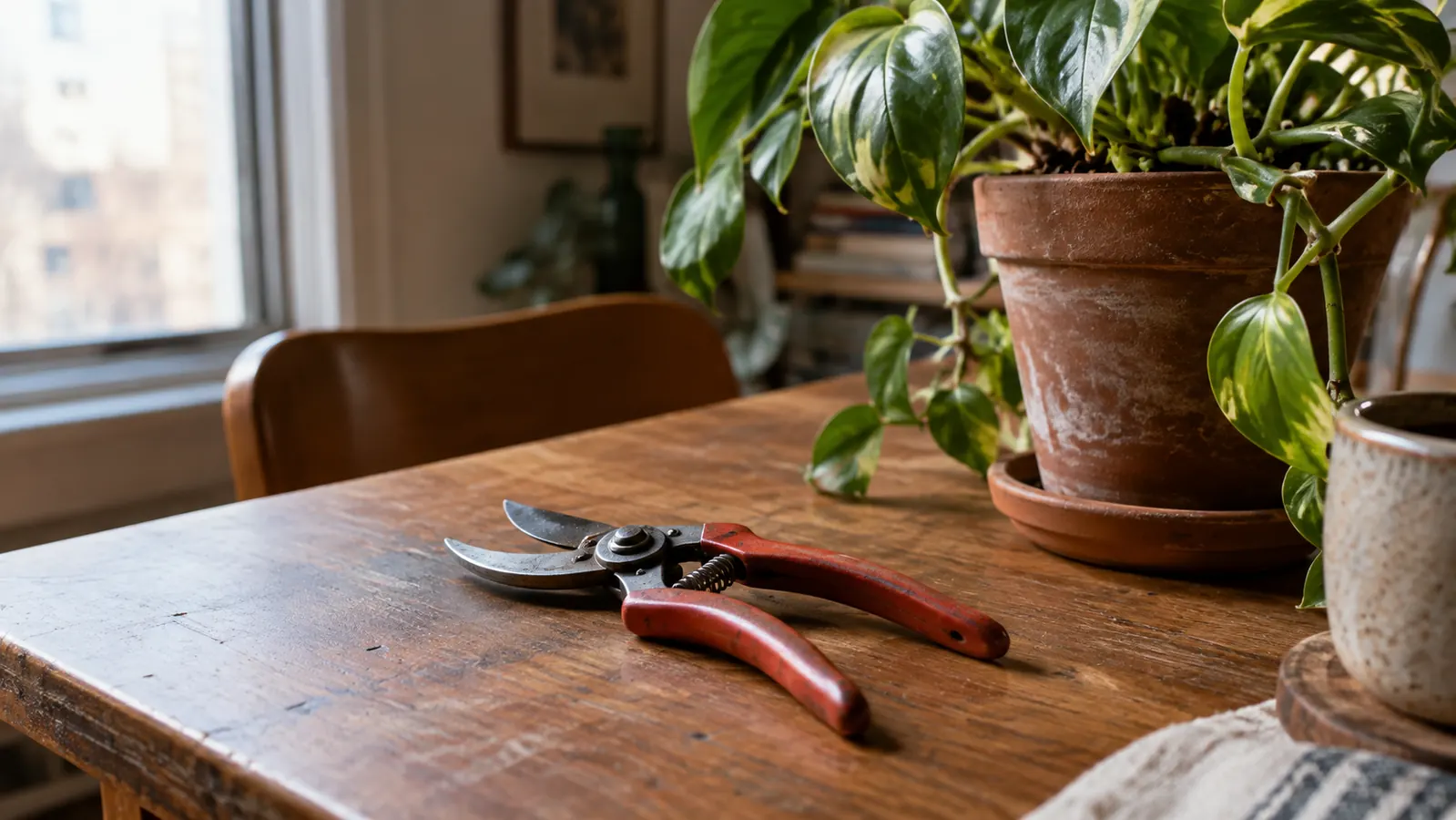
About a year ago I sat at my kitchen table in Portland with a pair of junk-drawer scissors, a fiddle leaf fig named Gus that I have kept alive for nine years, and a small pile of brown leaves that I was scared to cut. Every guide I read told me to make a clean cut just above a node. Every pair of scissors I owned crushed the stem instead of cutting it. I have killed a string of pearls, two calatheas, and a maidenhair fern, so I know exactly what bad plant care looks like. I bought the VIVOSUN Curved Gardening Scissors hoping they would stop the crushing. They did.
The honest version of this review is not the list of features on the product page. It is the story of what these shears looked like after a year of Sunday-morning trims, where the titanium coating actually held up, where it did not, and who should buy them. I have used this one pair on 31 houseplants, from Gus down to a trailing plant I am still coaxing through the winter, and I kept notes the whole way. No marketing copy, no borrowed claims, just what happened on my kitchen table.
The Quick Verdict
The best tool I have added to my plant routine in years, with one honest caveat: the titanium coating is real but not maintenance-free, and the blades need a dry wipe after every trim or they will spot.
Amazon Check Today's Price →This is the pair I reach for every Sunday morning.
A year of trims, roughly four hundred cuts, and the VIVOSUN shears still make clean cuts on everything soft I grow. Check today's price on Amazon and see the difference a curved blade makes.
Amazon Check Today's Price on Amazon →How I've Used It for a Year
This is not a lab test and I am not a professional gardener. I am a 46-year-old woman in a third-floor walk-up apartment in Portland with no yard, no balcony, and no greenhouse. My plants live in two rooms: the living room, where the east-facing window gives direct sun until about 11am, and the bedroom, where the north-facing window gives almost none. In winter the forced-air heat makes the whole place dry, which is why humidity comes up in every conversation I have about plants.
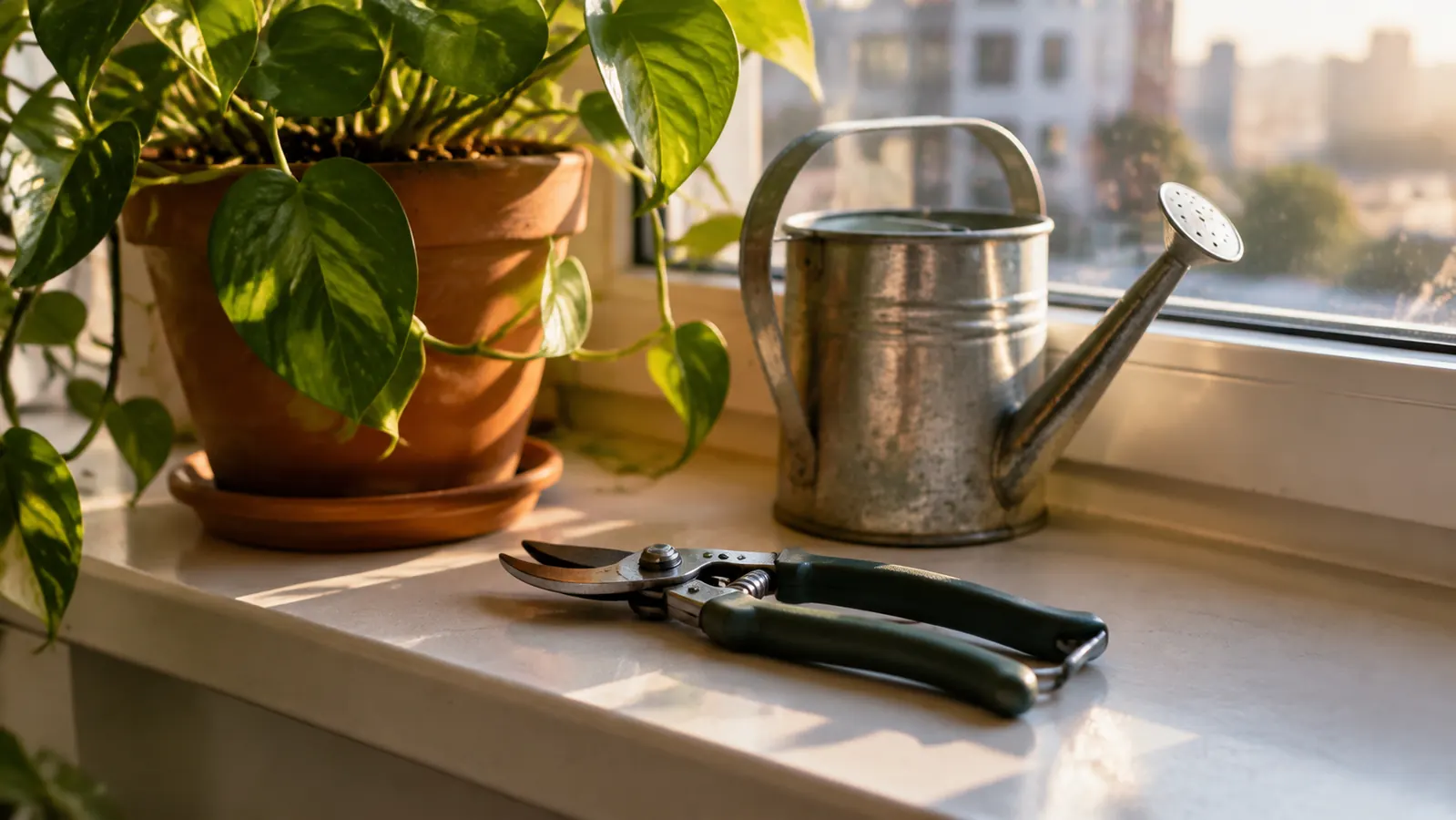
The shears live in a ceramic mug on the kitchen windowsill with a moisture meter and a twist tie. They come out every Sunday morning when I water. I water on Sundays because I cook most weeknights and commute by bike, so a weekday watering round never actually happens. While the watering can sits, I go through the plants and trim anything brown, anything leggy, or anything touching the glass of the east window. Everything that wants to live crowds around that window, and everything that crowds needs trimming.
In a year I have made roughly four hundred cuts with these shears. That is the real test: not one clean cut in perfect conditions, but four hundred cuts on stems of every thickness, with sap on the blades, with the lock slipping, with the spring doing whatever it does. These have trimmed pothos, philodendron, a ficus that drips white sap when you look at it, and the occasional brown leaf on Gus. Four hundred cuts is enough to know a tool.
What Nobody Tells You About the Titanium Coating
The product title says titanium coated blades, and that coating is the reason most people click buy. Here is the honest version of what that coating does after a year of use. The coating makes the blade surface slicker, so sap and plant juice bead up instead of gluing the blades shut. That part is real. My old kitchen scissors stuck together with dried sap within a month. These open smoothly after a trim, every time, and I credit the coating for that.
What nobody tells you is that the coating is not a shield. It wears off along the cutting edge with normal use, and it develops small marks if you let the blades sit wet. I learned this in month three. I trimmed a plant that dripped sap, wiped the blades once, and left them in the mug. Two weeks later there were fine spots along the edge. Not rust, exactly, more a dulling of the coating that I could see when the light caught it. The spots have not spread since I started drying the blades after every use, and they have never affected the cut.
The other thing nobody tells you: these are for plant stems, not for anything harder. I used mine to cut a twist tie once, out of laziness, and I felt the edge complain. Do not do that. This is a plant tool, and it should stay a plant tool. Use the kitchen scissors for the twist tie. That is the kind of advice that does not fit on a product page.
Here is the boring maintenance part, since nobody puts it on the product page. These shears need about thirty seconds of care after every use. I keep a small cloth in the same mug as the shears, and after a trim I wipe the blades dry and close them. That is it. No oil, no sharpening stone, no special storage. Twice this year I have wiped the pivot with a drop of cooking oil, the same oil I use on the bike chain, because the spring can get stiff if you ignore it for months. That is the entire maintenance schedule. If that sounds like too much, these are not the shears for you, and I say that with respect. Some people want a tool that survives neglect. This one survives care.
The Curved Blade Is the Real Story
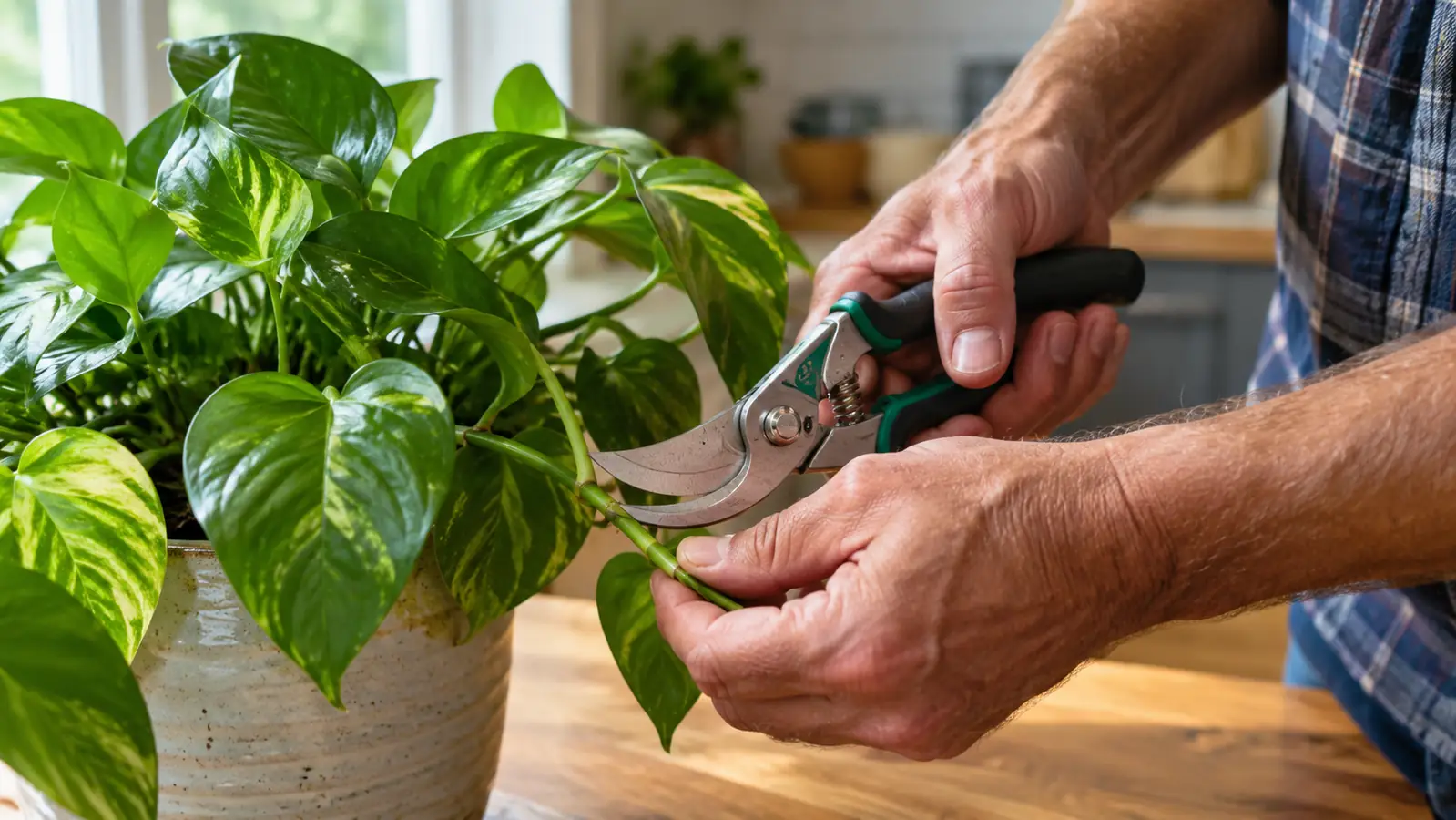
The curved blade is why I bought these and it is why I would buy them again. A curved blade hooks the stem slightly as you cut, which keeps the stem from sliding out between the blades. On straight scissors, a thin stem slides toward the pivot and you end up crushing it instead of cutting it. On these, the stem stays put and the cut stays clean. That single design choice has saved more of my plants than any fertilizer I have bought.
The difference shows up on soft growth. A pothos stem, a philodendron stem, anything thin and green, these cut through in one pass with a clean edge. A plant heals fast from a clean cut. The crushed stems from my old scissors went brown at the tip within a week, and I had to cut again, higher up, losing more of the plant. With a clean cut the tip stays green. That is the mechanical advantage, and it is real.
The grip is comfortable for my hands, and the spring opens the blades between cuts. This matters more than it sounds. When you are trimming a leggy plant and making forty cuts in a row, a spring that does the opening means your hand never tires. The lock is a simple slide switch, and it is the weakest part of the tool. It works, but it has loosened slightly over the year. It has never closed on its own in a way that hurt anything, but it is not a precision mechanism. The 6.5 inch size fits my kitchen-table setup well: small enough to reach into the middle of a crowded shelf, long enough for leverage on a woody stem.
The first time I used them, on a leggy pothos that had been sliding out of my junk-drawer scissors for months, the stem cut clean on the first pass. I actually said the words 'oh, that is how it is supposed to feel' out loud, alone, on a Sunday morning. That moment is the whole reason this review exists.
Where It Fell Short After a Year
Now the part the product page leaves out. Three things annoyed me in the first year. First, the sap problem is only half solved. The coating keeps sap from gluing the blades shut, but it does not keep sap off the blades. If you trim a sap-heavy plant and set the shears down without a wipe, the next cut drags. You need a cloth nearby. It is a small habit, but nobody tells you about it when you buy.
Second, the coating spots. I mentioned it above and it deserves its own line: leave these damp for a couple of weeks and you will see marks on the blades. They are cosmetic and they have not affected cutting, but they will make you think the coating is failing. It is not. The marks sit on the surface, and a dry wipe from day one would have prevented most of them.
Third, the blades are not sharp enough for thick woody stems in one pass. For soft green growth they are perfect. For a stem as thick as a pencil on a woody plant, they crush a little before they cut. I have learned to trim woody growth in two passes, which works, but if your collection is mostly trees in pots, you will notice the limit. These are shears for soft houseplant stems, full stop.
Alternatives I Considered
To be honest about why I kept these, I have to tell you what I compared them to. Kitchen scissors crush stems, and the junk-drawer kind go dull in a month. Cheap florist snips lost their edge even faster in my apartment. A friend gave me a pair of proper bypass pruners, and they are too big and heavy for kitchen-table work on houseplants, plus they are overkill for a pothos.
The closest honest comparison is a pair of stainless steel snips that cost more than the VIVOSUN. The stainless pair kept its edge longer and never spotted, but it cost more, and for soft houseplant stems the extra edge life never mattered. These shears do most of the job for less money. The small remaining gap, thick woody stems, is where a bigger bypass pruner earns its place.
If your collection is mostly small to medium houseplants, which mine is, the VIVOSUN is the right tool and you do not need anything else. If you are pruning a citrus tree or a woody shrub, buy a proper bypass pruner for those and keep these for the soft growth. That is the honest division of labor.
What I Liked
- Curved blade hooks thin stems so they cut clean instead of sliding and crushing
- Spring-loaded action keeps long trimming sessions easy on the hand
- Titanium coating keeps sap from gluing the blades shut
- Light and compact enough to live in a mug on the windowsill
- Still sharp for soft growth after a year of weekly use
Where It Falls Short
- Titanium coating spots if you leave the blades damp, so a dry wipe after every use is a must
- Not sharp enough for thick woody stems in one pass
- Slide lock loosens with use
- Needs a cloth nearby for sap-heavy plants
Four hundred Sunday-morning cuts in, the curved blade still hooks a stem cleanly on the first pass. That is the whole honest review.
What I Wish I Knew Before I Bought These
If someone had sat me down at this kitchen table a year ago and told me three things, I would have had an easier year. First, wipe the blades dry every time, even when you are in a hurry. Second, these are for soft stems, not for woody ones, not for twist ties, not for anything that is not a plant. Third, the titanium coating is a real help with sap, but it is a surface treatment, not armor. None of this would have stopped me buying them. All of it would have stopped me blaming the tool for my own habits.
The other thing I wish I knew is simpler. A good pair of shears does not make you a good plant keeper. I still killed a plant this year, and it was not the shears' fault. But a tool that cuts clean removes one variable from a hobby that already has plenty of variables: light, water, humidity, and my own tendency to overwater on Sunday mornings. That is worth something real.
Who This Is For
These shears are for the person who has a few houseplants, one good window, and a drawer full of scissors that crush every stem they touch. They are for apartment plant keepers who do their plant care at a kitchen table, not on a potting bench. They are for the person who has already killed a plant or three, me included, and wants the mechanical advantage of a clean cut. If you trim soft green growth every week, these are the right shears, and you will use them often enough to get your money's worth. That is the VIVOSUN buyer, and if it is you, buy them with confidence.
Who Should Skip It
Skip these if your plants are mostly woody, thick-stemmed, or tree-like. Skip them if you want a tool that needs zero care, because the titanium coating asks for a dry wipe after every use. Skip them if you are cutting anything that is not a plant stem. And skip them if you already own a good pair of florist snips that are still sharp, because the upgrade will be small. Also skip them if you only have a plant or two and you trim once a month, because a good pair of kitchen scissors that you keep sharp will do. These are honest limits. I would rather you buy the right tool for your actual plants than buy these because I like them.
Still the pair I reach for every Sunday morning.
A year of kitchen-table trims and these shears are still doing the job. If you have plants in pots and one window that works, this is the tool to keep next to the watering can. Check today's price on Amazon.
Amazon Check Today's Price on Amazon →