
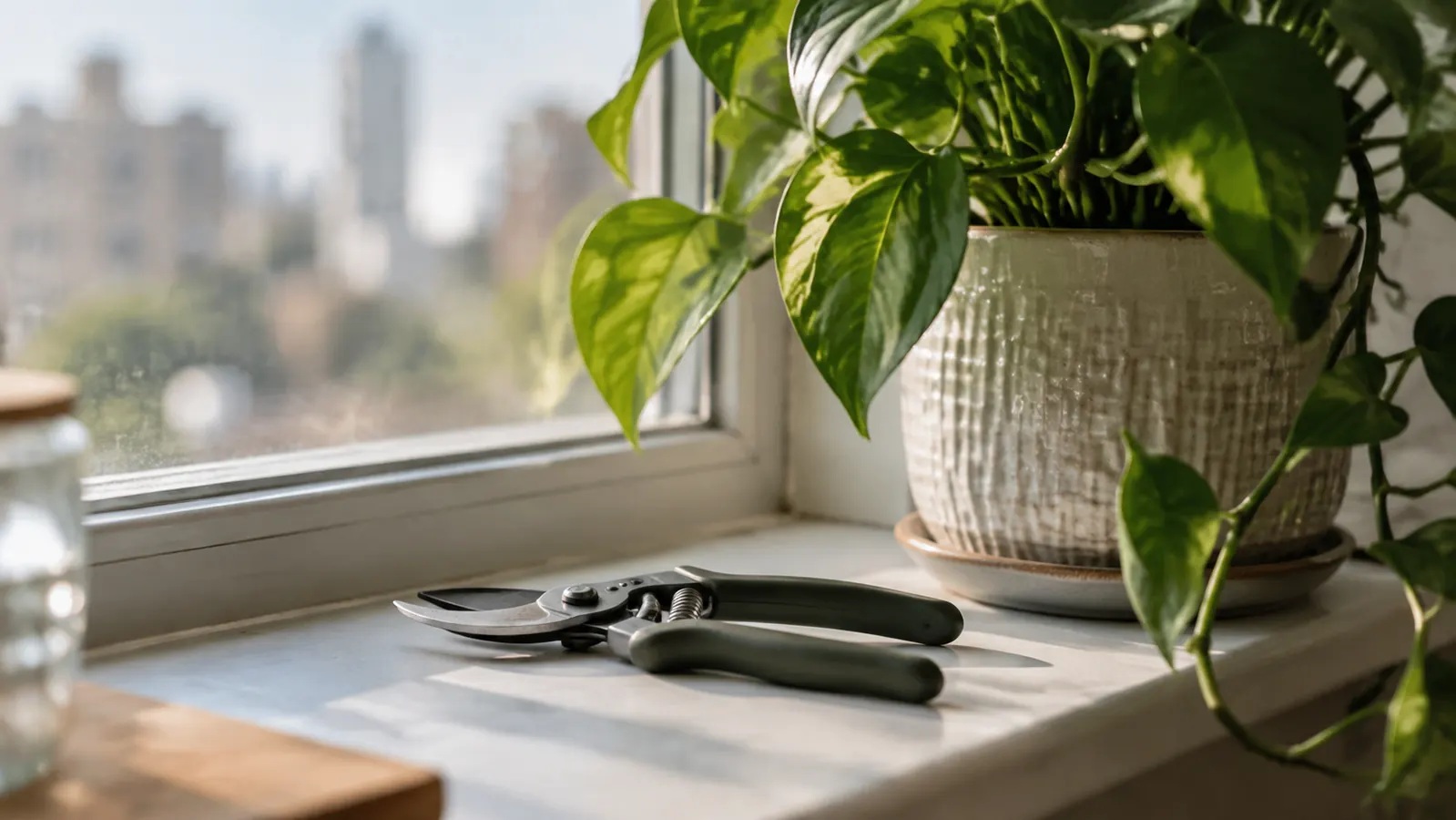
I bought the VIVOSUN pruning shears on a Sunday in March, the same morning I finally admitted my pothos was not fine. It was fine the way a houseplant is fine when you have stopped really looking at it. The vines ran along the top of the bookshelf, then hung down past the radiator, and every bare stretch between leaves was six inches long. I had been snipping at it with kitchen scissors for a year and a half, and the scissors were the problem. Kitchen scissors crush a stem more than they cut it. The crushed ends turned brown, then the brown crept backward into the healthy green, and I would come back two weeks later and cut again, higher up, making it worse.
I have 31 houseplants in a two-room apartment in Portland, with no yard, no balcony, and one genuinely good east-facing window. I am not an outdoor gardener and I never will be. I am someone who has killed a string of pearls, two calatheas, and a maidenhair fern, and who now buys tools to stop that from happening again. So the shears were not a treat for myself. They were a correction. The whole decision took about ten minutes. I read the reviews, which were almost suspiciously good, and I ordered them mostly because I was tired of being afraid of my own fig tree. That fear, it turns out, was the real problem. The shears were only part of the fix.
The Quick Verdict
Six months in, these are the shears I reach for every Sunday. They cut clean, they still hold an edge, and they made a leggy pothos look like a plant someone actually cares for.
Amazon Check Today's Price →The shears that fixed a year of ragged pothos cuts
If your plant looks fine from across the room and tired up close, the problem might be the tool you are cutting with. These curved shears give a clean cut on soft stems, and after six months of weekly use, mine still open and close like the day they arrived.
Amazon Check Today's Price on Amazon →How I've Used It
Every Sunday is watering day in my apartment. I cook most weeknights and commute by bike, so a weekday plant round never actually happens. The watering can and the shears live in the same basket, and they come out together.
Most Sundays the shears get light work. A yellowing leaf on the monstera, a spent flower stem on the African violet, a few crispy tips on the calathea I am still pretending might recover. The plants in the bedroom, which get the weakest light in the apartment, are the ones that need the most trimming. The tradescantia on the north windowsill grows toward the glass all winter, and by spring it is a tangle of bare stems. The cut is so clean I can hear the difference. It is a soft snip instead of the crunching sound kitchen scissors make.
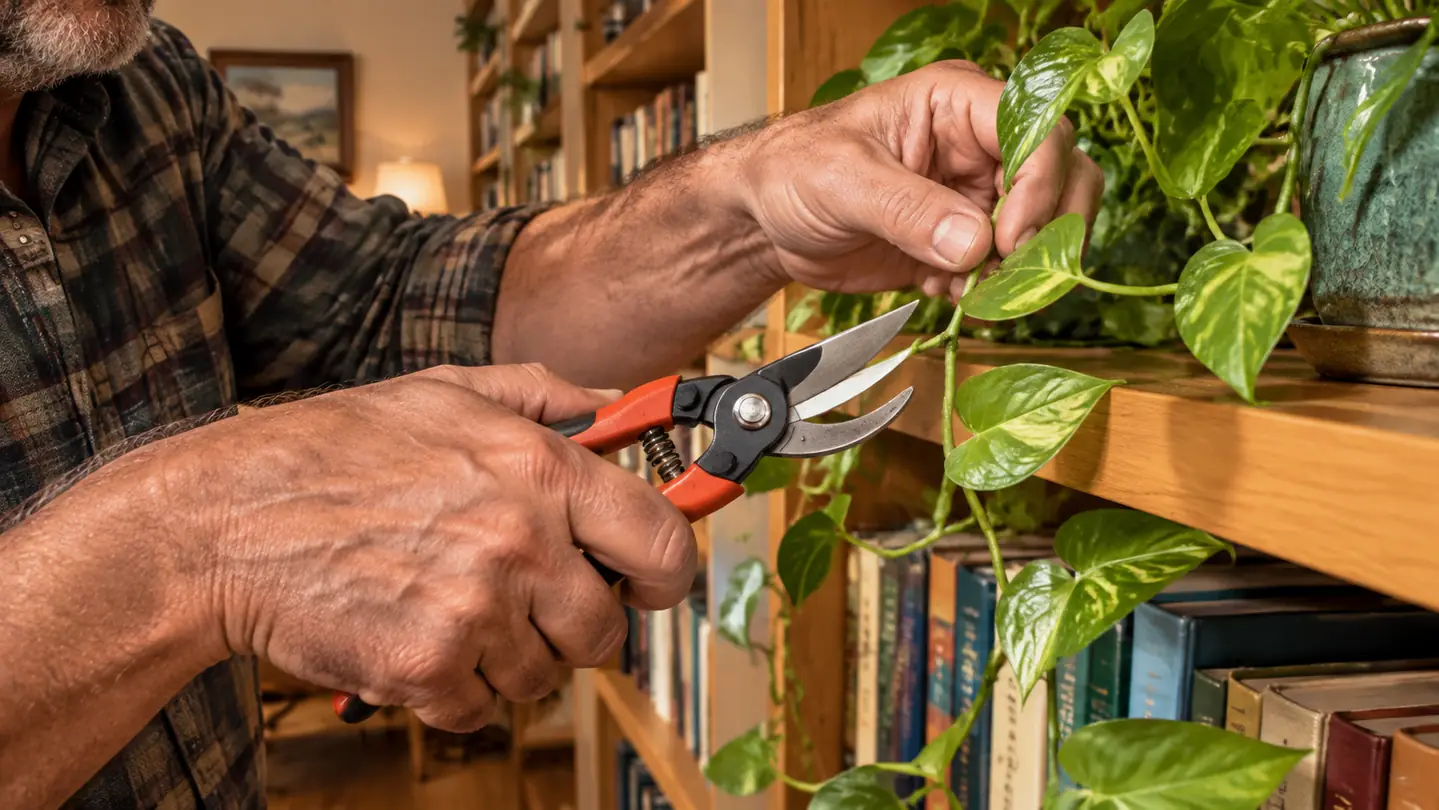
About once a month I do a real pruning session. In April I cut the pothos back hard, almost half the vines, and rooted the cuttings in a jar of water on the kitchen windowsill. In June I gave Gus the fiddle leaf fig his first real trim in nine years. He had grown tall and top-heavy, leaning toward the east window, and I was scared to cut him. The curved blades made it easier to reach into the canopy and cut on an angle, just above a leaf node, the way every plant care guide tells you to and I had never actually done.
Why I Stopped Using Kitchen Scissors
Every houseplant article eventually tells you to stop using kitchen scissors, and for a year I ignored that advice. They are already in the drawer, they are free, and they cut through a pothos stem fine if you do not look too closely at the result.
Look closely and the difference is obvious. Scissors from a kitchen drawer are ground to cut paper and chicken, not living stems. The blades are thick and flat, and they meet with a gap at the tip, so they pinch and crush before they sever. A crushed stem does not heal the way a clean cut heals. The cells at the wound are mashed, the tissue dies back, and you get that brown, dried-out tip that then travels down the stem.
The VIVOSUN shears are ground like a knife, not like scissors. The blades meet all the way along, so the cut is one motion instead of a squeeze and tear. I did not believe a tool could make this much difference until I cut one stem with the old scissors and the next stem with the shears and looked at both ends side by side. One was crushed and wet. The other was a clean diagonal line.
I looked at the expensive European brands that serious gardeners swear by. They are beautiful tools, and they were more than I wanted to spend on something that would mostly cut pothos stems. I also looked at the very cheap shears, the kind that come in a two-pack with a free pair of gloves. They felt flimsy in my hand, with a gap between the blades that would have crushed stems exactly the way my kitchen scissors did. The VIVOSUN pair sat in the middle, and middle is where I landed.
What the Curved Blade and the Coating Actually Do
The curve is not decorative. It puts the cutting edge closer to the work, so you can cut with the blades almost flat against the stem instead of approaching it at an awkward angle. When a pothos has woven itself through a bookshelf, that matters. You can slip the curved jaw behind a vine that is pressed against the wall and get a clean cut without pulling the vine out first.
The titanium coating on the VIVOSUN blades gets talked about like it is the whole product, but after six months what I have noticed is simpler. Sap does not stick the way it stuck to my kitchen scissors. When I cut Gus in June, the fig sap that would have glued my old scissors shut just beaded up and wiped off with a rag. The blades have not rusted, and I have not sharpened them once. I wipe them with a dry cloth after each session, and that is the entire maintenance routine.
The handles matter more than I expected. They are curved to sit in the hand, and the spring between them opens the shears after every cut. Pruning a whole pothos with kitchen scissors leaves your hand cramping by the end. These do not, because the work is in the cut, not in forcing the blades back open.
Six Months In: What Still Works and What Wears
Six months is not a long time for a good pair of pruners. A gardener using a tool like this on real outdoor plants would laugh at my definition of long-term. But for an indoor plant keeper, six months of weekly use is the difference between a tool that gets used and a tool that gets lost in a drawer.
What still works: the cut quality is identical to March. The spring is still snappy. The safety lock, which I was sure I would hate, now gets used every time I put the shears away, because they live in a basket with the watering can and I would rather not grab the blades by accident.
What wears: the coating has fine scratches near the tip from cutting thicker stems, purely cosmetic. The soft-touch grip picks up plant dirt and shows it. And the lock has gotten slightly looser, though it has never once slipped while the shears were stored. I also wipe the blades after every session, even the light ones. Fig sap is sticky, and if it dries on the blade it is harder to remove next time. With the kitchen scissors I never bothered, because they went back in the drawer with the cutlery. The shears live with the plant tools, so wiping them down is part of the Sunday routine, like rinsing the watering can.
The real test, the one I did not plan, was the pothos. I cut half the vines in April. By September the plant that had looked tired and bald at the top was full again, with new growth at every node where I had cut. That is the part no one tells you about pruning. The cut itself is what wakes the plant up.
The pothos I cut back in April was bald at the top and tired all the way down. By September it was full again, with new growth at every node I cut.
The Tradeoffs Nobody Puts in the Listing
Here is what I would want to know before buying. The 6.5 inch size is on the small side. For me, with average-sized hands, it is perfect. My partner, who has larger hands, finds the handles short and has to grip them closer to the blades. If your hands are large, try them before you buy or be ready to send them back.
These are for stems, not for woody branches. The listing says up to about half an inch, and I would not push past that. I tried to cut a dried-out branch on an old rosemary that had gone woody, and it took two hands and a lot of stubbornness. For a houseplant collection that is mostly soft-stemmed, this is fine. It is the wrong tool for anything woody.
The lock is a two-step dance at first. It slides forward to unlock and back to lock, and for the first week I kept trying to squeeze the handles with the lock still on. That is how I learned the spring does not care about your frustration. None of these are dealbreakers. They are the reasons it is a 4.5 star tool and not a fictional perfect one.
Why a Clean Cut Matters More Than You Think
Here is the part I did not believe until I saw it happen on my own shelf. A clean cut is not just about how the plant looks at the wound. It is about what happens next.
When I used kitchen scissors, the crushed ends on my pothos turned brown, and the brown kept creeping. I would cut above the brown, crush the stem again, and the plant would retreat further. Every time I pruned, I was injuring the plant a second time.
With a clean diagonal cut, the wound seals quickly and the plant sends out new growth from the node just below the cut. My pothos has two new vines where I made the April cuts. The tradescantia, which I cut back in May because it was a leggy mess, is now the plant people comment on when they visit, which for a houseplant in a rental apartment is the highest compliment available.
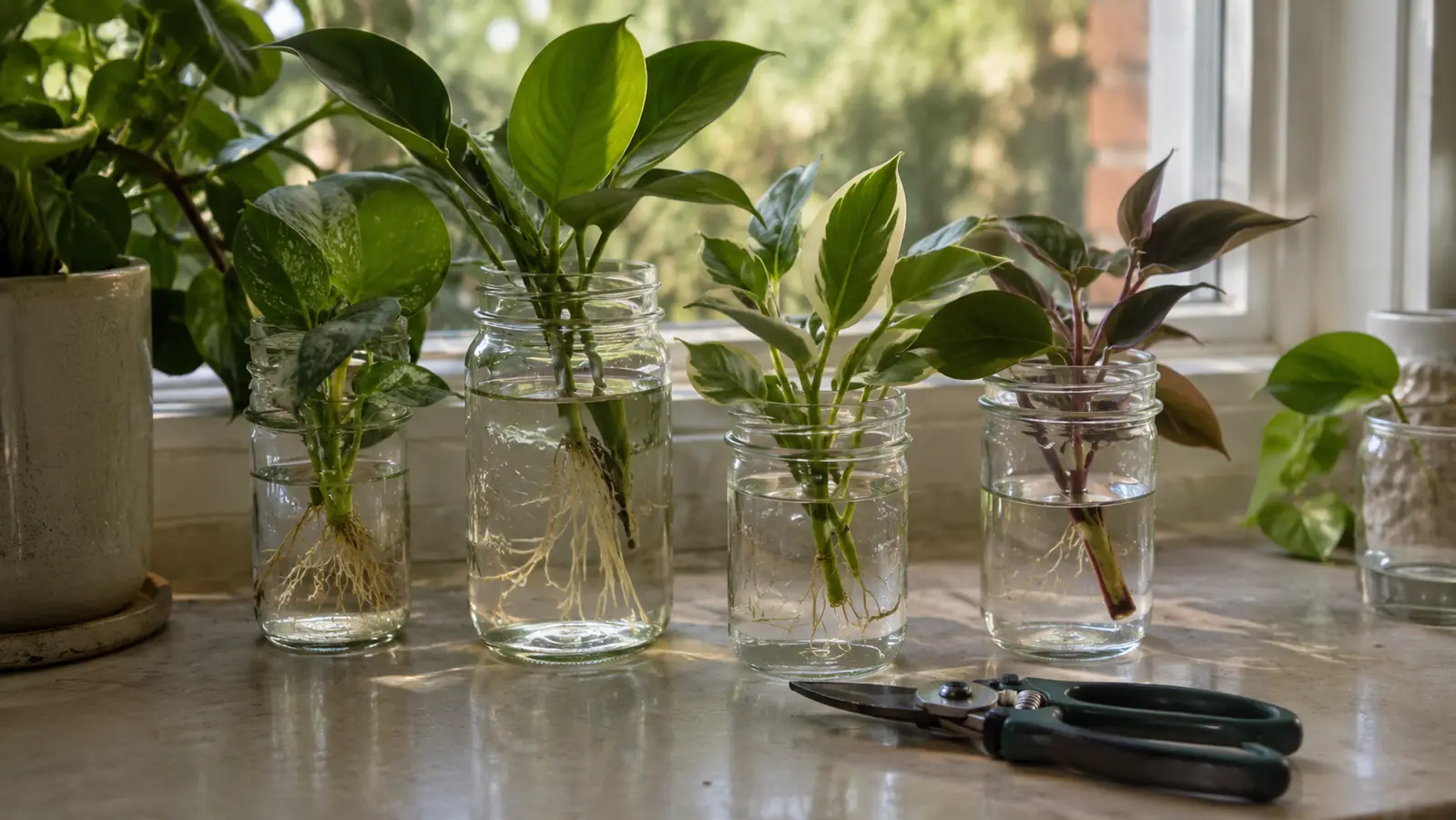
The same goes for cuttings. Every cutting I took with these shears rooted. Every single one. With kitchen scissors, maybe half rooted, because the crushed stem ends rotted in the water before roots could form. Right now there is a jar on the kitchen windowsill with four pothos cuttings that started as trims, and all four have roots.
If you only cut once a month, the difference between a cheap tool and a good one is the difference between a cut that heals and a cut that hurts. That is the whole review in one sentence.
What I Liked
- Clean, crush-free cuts on soft stems up to about half an inch
- Curved blades reach vines pressed flat against walls and shelves
- Sap and plant dirt wipe off the coated blades in seconds
- Self-opening spring saves your hand during big pruning sessions
- Safety lock means they can live loose in a basket with other tools
- Still sharp after six months of weekly use with zero maintenance
Where It Falls Short
- Handles run short for larger hands
- Not built for woody branches or outdoor shrubs
- Soft-touch grip shows dirt and stains
- Lock takes a week of fumbling before it feels natural
Who This Is For
These shears are for the indoor plant keeper who has been making do with whatever is in the kitchen drawer and is tired of the brown, crushed ends. If you have houseplants that need regular trimming, if you take cuttings to root in water, if you have a fig or a monstera that has outgrown its corner, the VIVOSUN shears will do everything you need and nothing you do not. They are also for the person who is, like me, not a gardener. I am never going to prune an orchard. I need one tool that cuts a pothos stem cleanly, fits in the basket with the watering can, and does not make my hand cramp. This is that tool.
Who Should Skip It
Skip these if your hands are large, because the handles will be short for you. Skip them if most of your cutting is woody, rose canes, outdoor shrubs, dried lavender stalks. For that work you want a heavier bypass pruner with real leverage. And skip them if you prune once a year, because then the kitchen scissors are honestly fine. A tool earns its place in the basket when it gets used every week. A tool you reach for once a year is a tool you should not have bought.
The one tool that actually changed how my plants grow
Six months in, the pothos is full, every cutting rooted, and the shears still cut like they did in March. If your plant care routine is one step away from kitchen scissors, this is the upgrade.
Amazon Check Today's Price on Amazon →