
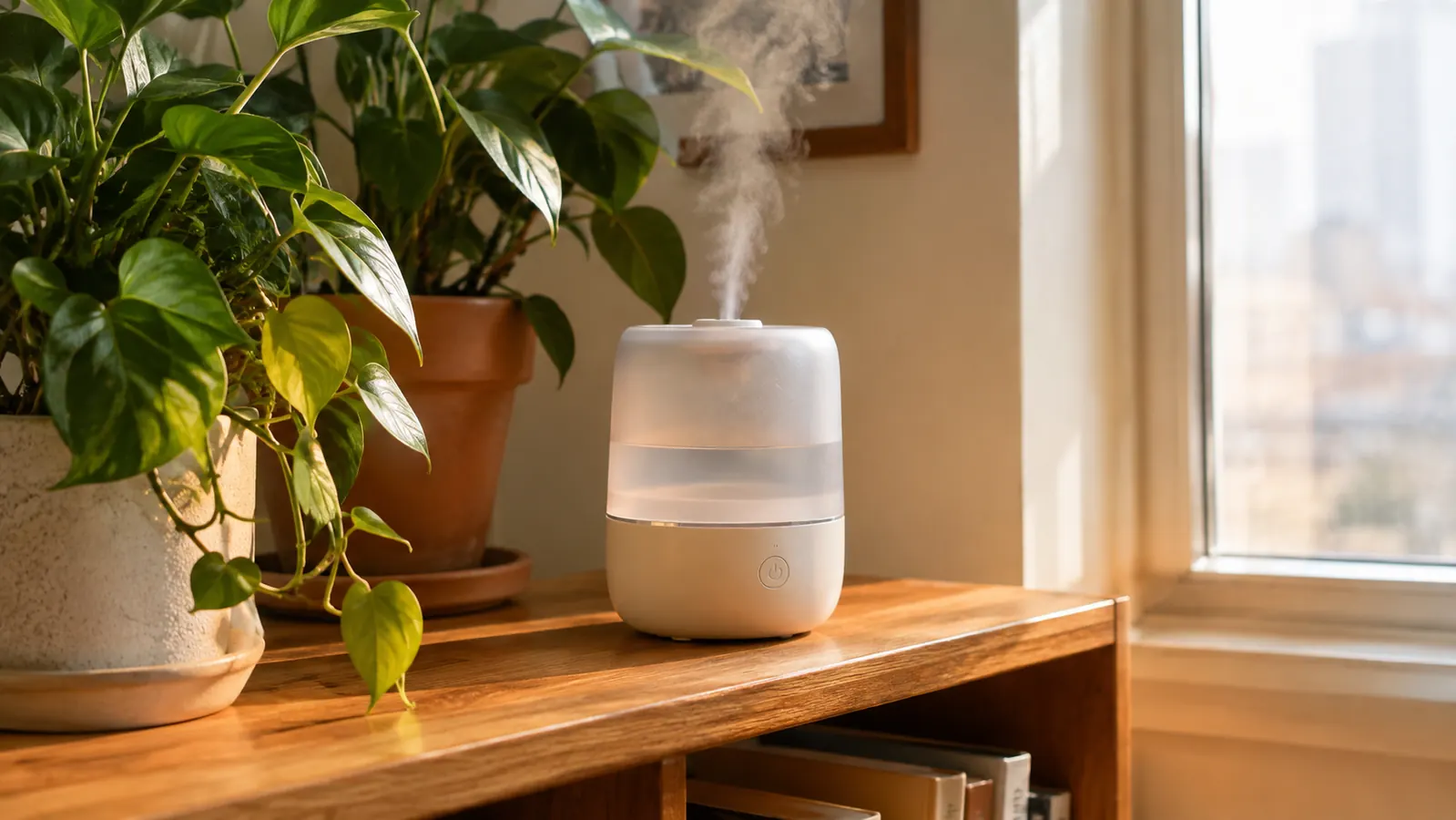
Every January, the same thing happens in my apartment. The forced-air heat kicks on, the air dries out, and within two weeks the leaves on my plants start browning at the edges. I say 'starts,' but honestly, the first winter I lived here, it went past browning to full collapse. I lost two calatheas and a maidenhair fern before I figured out that the problem was not the light, not the watering, and not the pot. It was the air itself. The humidity in a heated apartment in Portland drops to the high 20s, and a tropical plant that evolved in rainforest air simply cannot keep its leaf edges alive in that.
Here is what I learned the hard way, and what this guide walks through step by step: tropical houseplants want humidity around 50 to 60 percent, and most heated apartments sit at 25 to 35 percent from November through March. No amount of careful watering fixes dry air. The water you pour into the pot just evaporates faster, and the soil stays damp while the leaves keep crisping. What actually fixed it for me was a small humidifier running near the plants. I use a MOVTIP Portable Mini Humidifier with a 500ml tank, and I run it every winter now. The rest of this guide is exactly how I set it up, where I put it, and what I would do differently if I were starting over today.
The humidifier I run every winter, and how to place it so it actually works
The MOVTIP Portable Mini Humidifier holds 500ml, sits quietly on a shelf or nightstand, and is the one I reach for when the heat comes on. If your plants are browning at the edges, this is the setup that stopped it for me. Check today's price on Amazon.
Amazon Check Today's Price on Amazon →Step 1: Measure the Actual Humidity Before You Change Anything
You cannot fix a number you have not measured. I spent an entire first winter guessing, running the humidifier at odd hours, keeping the kitchen window shut, and I still lost a calathea because I was chasing the wrong problem. A basic hygrometer from a hardware store or online costs very little and tells you the real humidity in each room. It changes more than you expect. My living room reads 28 percent on a clear January morning and 45 percent on a rainy March afternoon. My north-facing bedroom reads lower all year because that window stays shut.
Measure in the spot where your plants actually sit, not on the kitchen counter. Hold the hygrometer next to the plant for ten minutes and write the number down. Do this three days in a row, morning and evening, so you see the range instead of one lucky reading. That range tells you whether you need a humidifier at all. Some apartments hold 50 percent through the winter without any help. Mine does not, and yours probably does not either if the leaves are already telling you.
One more thing the numbers taught me: humidity is not the same as watering. My soil was moist, sometimes too moist, and the leaves were still crispy. The hygrometer showed why. The air was pulling moisture out of the leaves faster than the roots could replace it, no matter how much water sat in the pot. That single realization changed how I thought about every dry-winter problem with my plants, and it is the reason I now check the air before I change anything else.
Step 2: Put the Humidifier in the Right Place, Which Is Not Across the Room
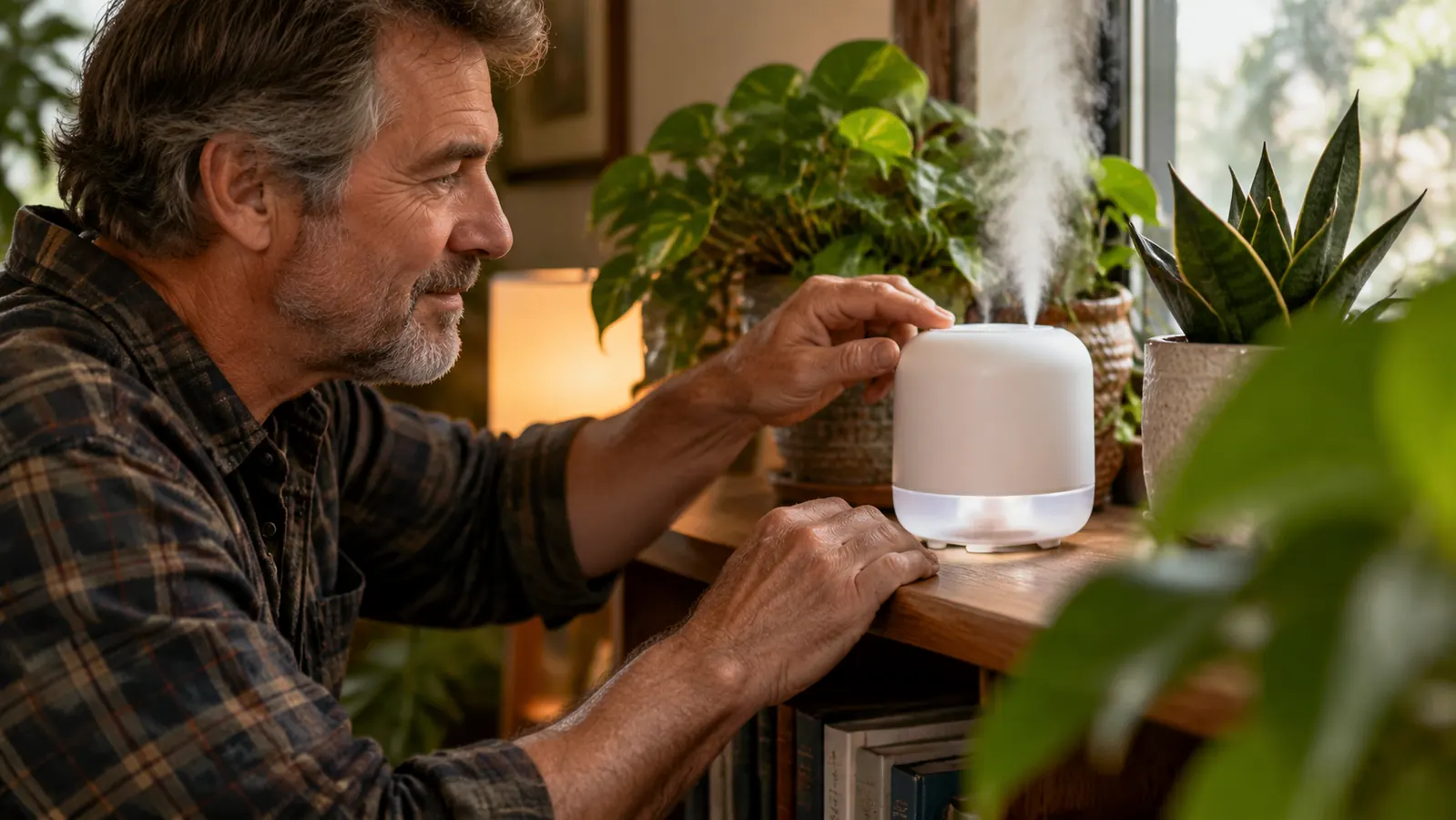
The biggest mistake I made the first winter was putting the humidifier on my desk, ten feet away from the plants, because that was where the outlet was. It did almost nothing. A small humidifier raises humidity in a local area, not a whole apartment. The mist comes out, mixes with the air right around it, and by the time it travels across the room, the plant in the corner is still sitting in 30 percent air. Place the humidifier within two or three feet of the plants you are trying to help.
Raise it off the floor. Humidity settles, and a humidifier sitting on the floor mostly humidifies the floor. I keep mine on a low bookshelf at about the same height as the plant leaves, so the mist has a chance to mix with the air the leaves are actually breathing. Aim the mist outlet toward the plants, but not directly at a single leaf. A constant stream of mist landing on the same leaf for hours can leave water spots or encourage mold. You want humid air around the plant, not droplets on the leaf.
This is where a small unit earns its keep. The MOVTIP is a 500ml portable humidifier, so it fits on a shelf, a nightstand, or the corner of a desk without taking over the room. I move mine between the living room and the bedroom depending on which plants need the help, and because it is light and small, I actually do move it instead of leaving it in the wrong spot out of laziness. If it were a big console unit, it would live in one place and I would make do. Small means it ends up where it is useful.
Step 3: Use Water That Will Not Leave White Dust on the Leaves
Tap water in most cities contains minerals. When a humidifier turns that water into mist, the minerals stay behind and settle as a fine white dust on the leaves, on the shelf, and inside the humidifier itself. On plant leaves, that dust is not just ugly. It can clog the pores the leaf uses to breathe, and it makes the plant look sick even when it is not. The fix is simple: use distilled water, or filtered water if your tap is reasonably soft.
I keep a jug of distilled water under the kitchen sink from November through March. It is cheap, and it saves me from wiping white film off every leaf in the living room every week. If you use tap water instead, plan to clean the humidifier more often and wipe the leaves down monthly with a damp cloth. The humidifier itself will also last longer on distilled water. Mineral buildup is what kills small ultrasonic units, and a small humidifier that dies in two seasons because of hard tap water is not actually a bargain.
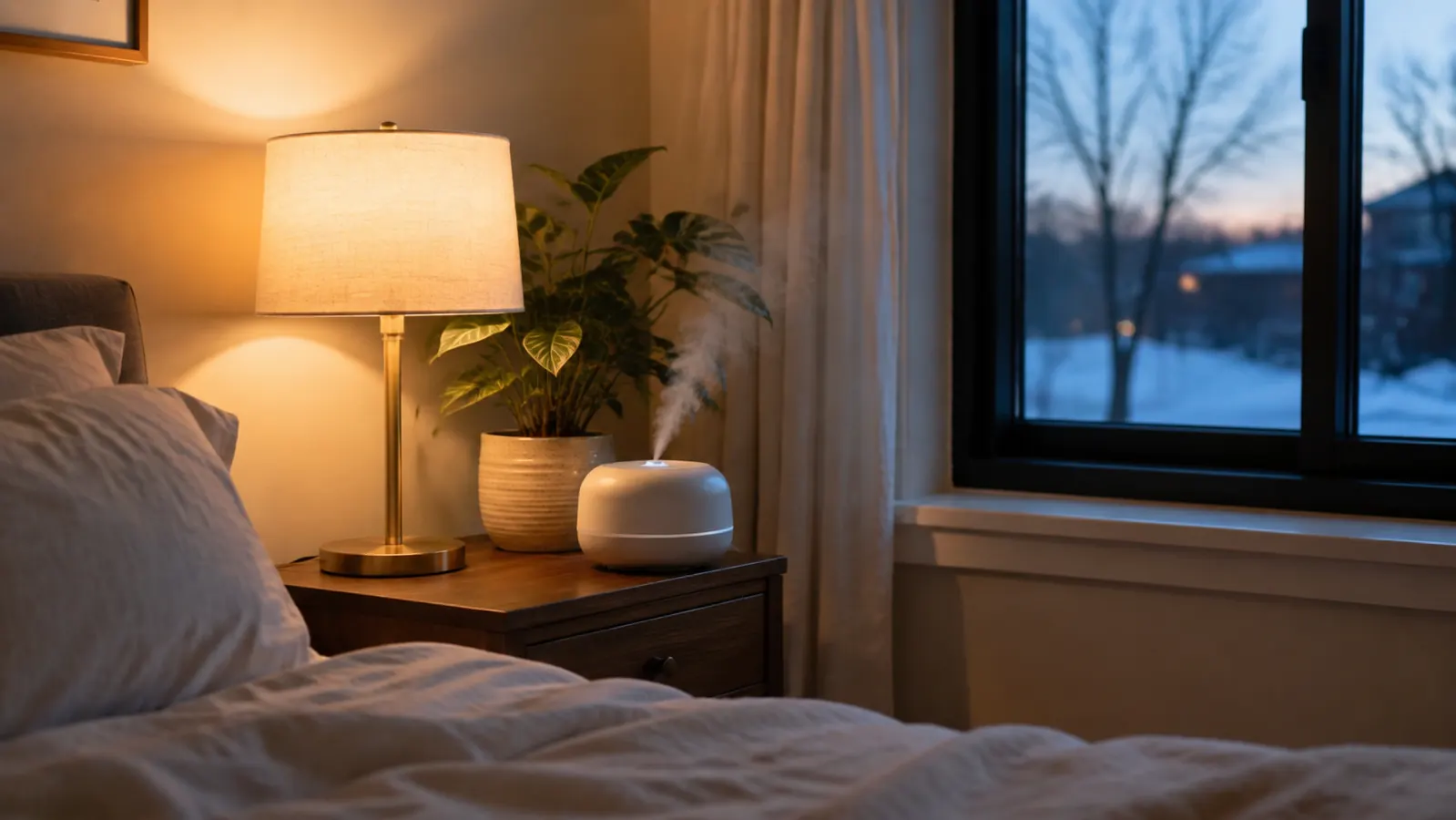
The 500ml tank on the MOVTIP holds a little under a pint of water. That is enough for one overnight run or most of a workday. I refill it every morning and use roughly a gallon of distilled water every two days. If your plants are spread across two rooms, think about whether one small tank is enough or whether you need two units, one per room. I have one, and I rotate it, because most of my plants live in the living room. The two plants in the bedroom get the humidifier at night, when they are the ones that need it.
Step 4: Run It on a Schedule Tied to Something You Already Do
The most reliable schedule is not 'whenever I remember.' It is a schedule attached to a habit that already exists. I water on Sunday mornings because that is the one morning I am home without rushing anywhere. The humidifier follows the same logic. I fill it when I make coffee, run it for an hour or two in the morning, then refill it before bed for an overnight run. The plants get a long stretch of higher humidity overnight, when the heat is cycling on and off and the air is at its driest.
You do not need to run a small humidifier 24 hours a day. In fact, you should not. Constant mist keeps the soil surface wet and can invite fungus gnats, and it wastes water and attention. I aim for two to three hours in the morning and six to eight hours overnight, and that keeps the humidity around my plants in the mid-40s to low 50s instead of the high 20s. A cheap outlet timer makes this automatic. I tried to run it manually for a month and I failed, not from laziness but from routine. The timer removed the whole problem.
Watch for the one sign of overdoing it: a damp shelf or windowsill under the humidifier in the morning. If the wood feels wet, cut the run time back. You are looking for higher air humidity, not a wet corner. The goal is the plant's leaves staying supple, not the room feeling like a greenhouse.
Step 5: Watch the Leaves, Then Adjust
The humidifier is a tool, not a set-and-forget device. After two weeks on the schedule, look at the plants. New growth is the first sign that things are working. A calathea that stalled all winter will push out a new leaf. The older leaves will still carry their brown tips, because damaged leaf tips do not heal, but the new growth will be clean. That contrast, old damage and clean new leaves, is the signal that the humidity is finally high enough.
If the new leaves are still crisping at the edges, raise the humidity in one of two ways: run the humidifier longer, or move it closer to the plant. If you see mold on the soil surface or the leaves look soft and limp, you have gone too far, so cut the run time back. I check the hygrometer next to the fiddle leaf fig once a week and adjust the timer by half an hour in either direction. That is the entire maintenance routine, and it takes less than a minute.
Weekly cleaning belongs in this step too. Once a week, I empty the tank, wipe the inside with a cloth, and rinse the mist outlet under the tap. It takes two minutes. Skip it and the unit gets louder, the mist gets thinner, and you are back to square one in February wondering why the leaves are browning again. A clean small humidifier runs better than a neglected big one, and a 500ml tank is small enough that cleaning it is not a chore.
What Else Helps
The humidifier did the heavy lifting, but it was not the only thing that changed in my apartment. I also moved the plants off the heat register and away from the drafty window, which I should have done years before. A pebble tray, a shallow dish of water and stones under the pot, adds a little local humidity and costs almost nothing. Grouping plants together helps too, because each plant releases moisture and together they create a small pocket of humid air around themselves. I have to be honest about misting: a spray bottle did almost nothing for me. The effect lasts minutes, and then you are back to dry air. The humidifier lasts hours.
If you are deciding whether to buy a humidifier at all, do the measurement in Step 1 first. If the air around your plants reads above 45 percent in winter, you may not need one. If it reads in the 20s or low 30s, a small humidifier is the fix that actually matches the problem. I wish someone had told me that before I lost the fern.
One honest caveat: a 500ml humidifier is not going to turn a large, open living room into a rainforest. It makes a difference in the two or three feet around it, which is exactly where my plants sit. If your plants are scattered through a big open plan space, you may need a second small unit or a larger one, and you should size that expectation before you buy. For my setup, one small unit moved the number that mattered.
The humidifier did not fix everything in my apartment. It fixed the one number that was actually wrong: 28 percent humidity in January, up to the mid-40s around the plants by March.
If your leaves are crisping, start here
Measure the humidity first, then place a small humidifier close to the plants and run it on a schedule you can keep. The MOVTIP Portable Mini Humidifier is the one I run every winter now. Check today's price on Amazon.
Amazon Check Today's Price on Amazon →